

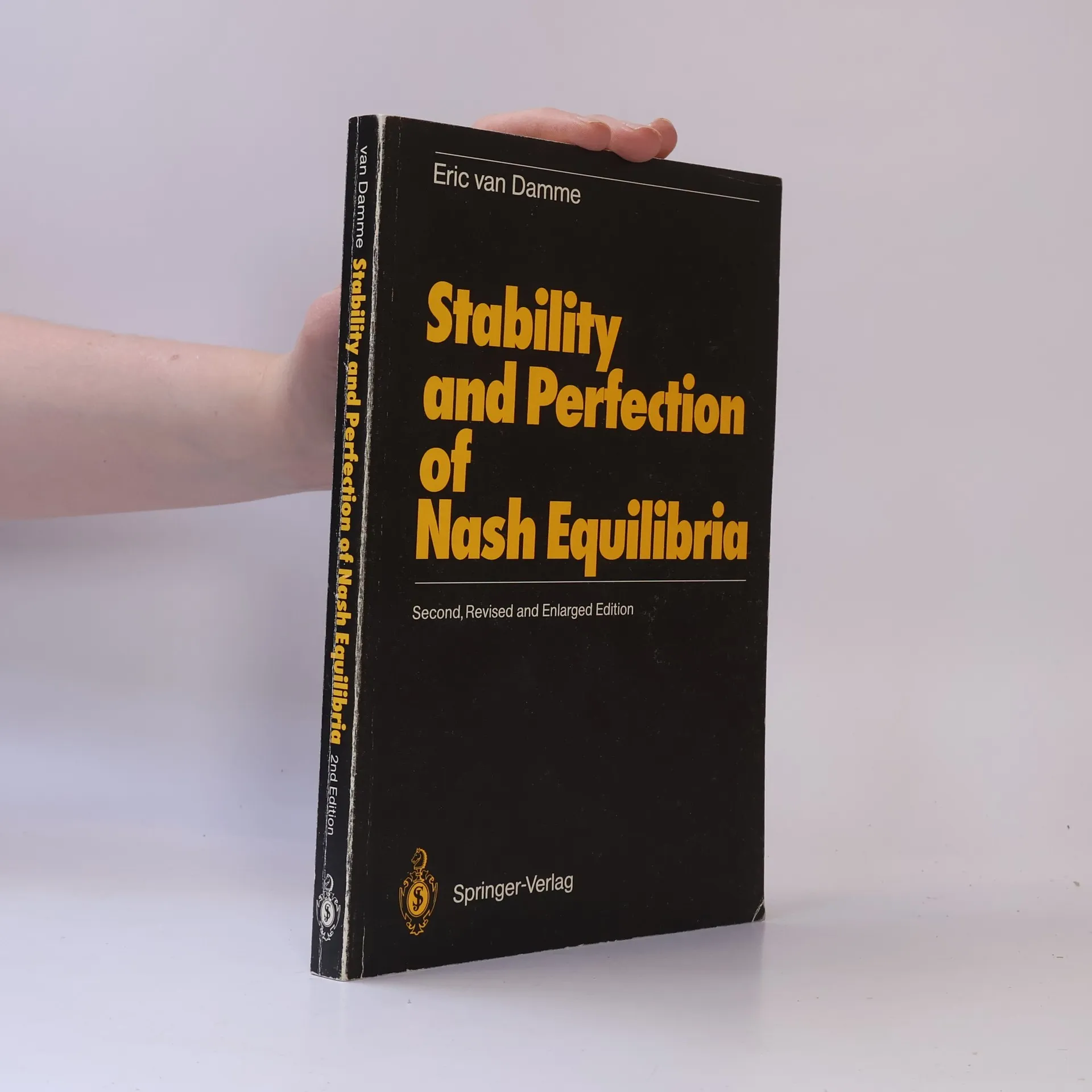


Stability and Perfection of Nash Equilibia: Second, Revised and Enlarged Edition
Autor*innen
Parameter
- 339 Seiten
- 12 Lesestunden
Mehr zum Buch
This book discusses the main shortcomings of the classical solution concept from noncooperative game theory (that of Nash equilibria) and provides a comprehensive study of the more refined concepts (such as sequential, perfect, proper and stable equilibria) that have been introduced to overcome these drawbacks. The plausibility of the assumptions underlying each such concept are discussed, desirable properties as well as deficiencies are illustrated, characterizations are derived and the relationships between the various concepts are studied. The first six chapters provide an informal discussion with many examples as well as a comprehensive overview for normal form games. The remaining chapters are devoted to specific applications, illustrating the strength (resp. weakness) of the various concepts.
Buchkauf
Stability and Perfection of Nash Equilibia: Second, Revised and Enlarged Edition, Eric van Damme
- Sprache

- Erscheinungsdatum
- 1991
- Einband
- (Paperback)
Keiner hat bisher bewertet.
- Titel
- Stability and Perfection of Nash Equilibia: Second, Revised and Enlarged Edition
- Sprache
- Englisch
- Autor*innen
- Eric van Damme
- Verlag
- Springer
- Erscheinungsdatum
- 1991
- Einband
- Paperback
- Seitenzahl
- 339
- ISBN10
- 0387538003
- ISBN13
- 9780387538006
- Reihe
- Kategorien
- Schlagwörter
- Handel, Psychologische Thematik, Mathematische Analyse
- Beschreibung
- This book discusses the main shortcomings of the classical solution concept from noncooperative game theory (that of Nash equilibria) and provides a comprehensive study of the more refined concepts (such as sequential, perfect, proper and stable equilibria) that have been introduced to overcome these drawbacks. The plausibility of the assumptions underlying each such concept are discussed, desirable properties as well as deficiencies are illustrated, characterizations are derived and the relationships between the various concepts are studied. The first six chapters provide an informal discussion with many examples as well as a comprehensive overview for normal form games. The remaining chapters are devoted to specific applications, illustrating the strength (resp. weakness) of the various concepts.