


Mehr zum Buch
This textbook stands out for its in-depth presentation of the calculus of moving surfaces, an extension of tensor calculus to deforming manifolds. Aimed at advanced undergraduate and graduate students, it encourages a fresh perspective on previously learned material through tensor calculus. After mastering the foundational framework, students explore new topics such as differential geometry on manifolds, shape optimization, boundary perturbation, and dynamic fluid film equations. The language of tensors, essential for technical scientists, is presented with clarity and relevance, showcasing its classical roots while demonstrating its ongoing significance. The author's adept lecturing is reflected in the inclusion of insightful examples and numerous exercises. Emphasis is placed on geometric fundamentals, mechanics of variable changes, proper tensor notation, and the relationship between algebra and geometry. Early chapters prioritize concepts over equations, with the definition of a tensor introduced in Chapter 6, ensuring readers are adequately prepared. While maintaining rigor, the text avoids excessive formalization. The final sections focus on the Calculus of Moving Surfaces, presenting it as a groundbreaking technique with applications in shape optimization, boundary value problems, and dynamic fluid film equations. Additionally, this framework offers new derivations of classical results, including the geodesic equation a
Buchkauf
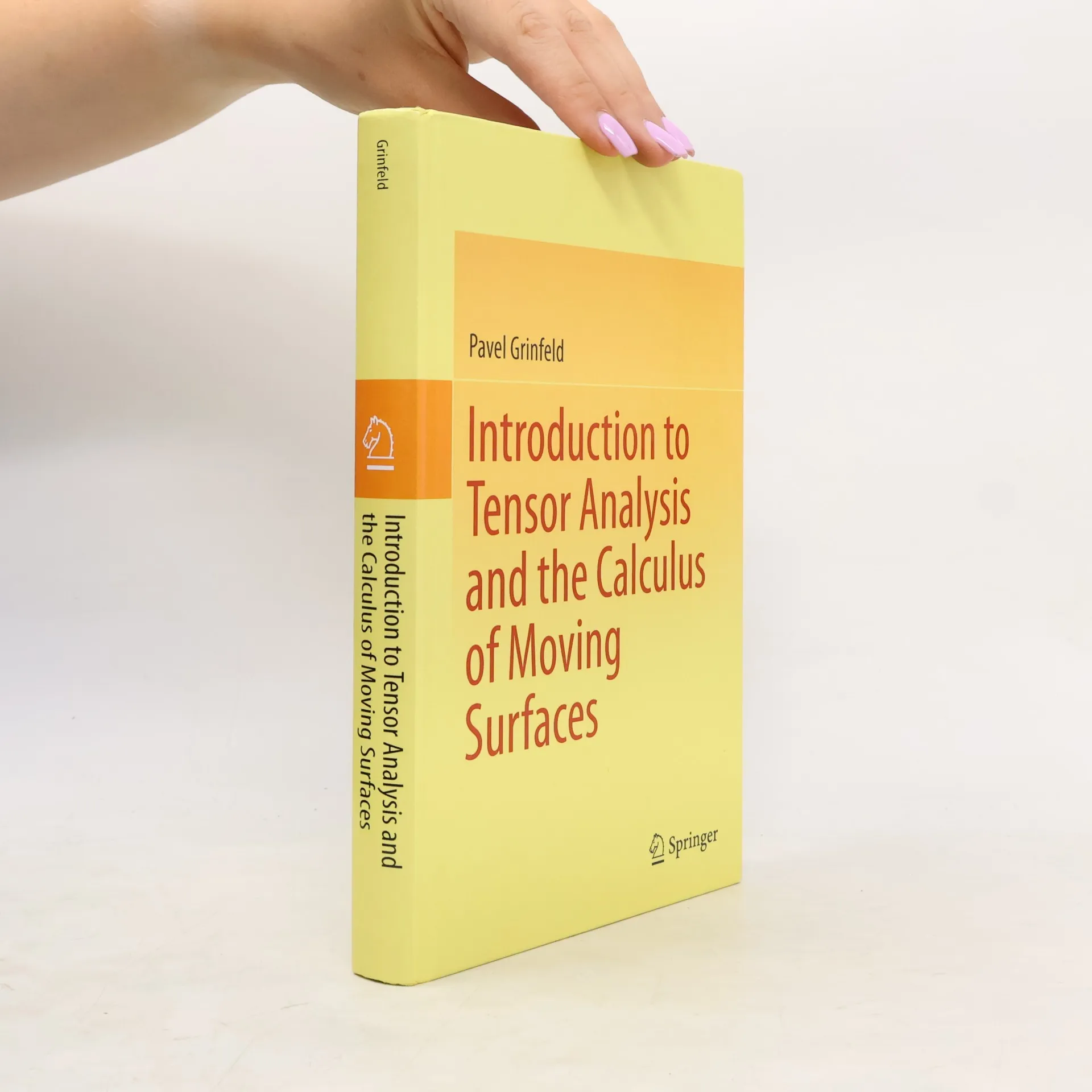
Introduction to Tensor Analysis and the Calculus of Moving Surfaces, Pavel Grinfeld
- Sprache

- Erscheinungsdatum
- 2013
- Einband
- (Hardcover)
Keiner hat bisher bewertet.
- Titel
- Introduction to Tensor Analysis and the Calculus of Moving Surfaces
- Sprache
- Englisch
- Autor*innen
- Pavel Grinfeld
- Verlag
- Springer New York
- Erscheinungsdatum
- 2013
- Einband
- Hardcover
- Seitenzahl
- 315
- ISBN10
- 1461478669
- ISBN13
- 9781461478669
- Reihe
- Schlagwörter
- Beschreibung
- This textbook stands out for its in-depth presentation of the calculus of moving surfaces, an extension of tensor calculus to deforming manifolds. Aimed at advanced undergraduate and graduate students, it encourages a fresh perspective on previously learned material through tensor calculus. After mastering the foundational framework, students explore new topics such as differential geometry on manifolds, shape optimization, boundary perturbation, and dynamic fluid film equations. The language of tensors, essential for technical scientists, is presented with clarity and relevance, showcasing its classical roots while demonstrating its ongoing significance. The author's adept lecturing is reflected in the inclusion of insightful examples and numerous exercises. Emphasis is placed on geometric fundamentals, mechanics of variable changes, proper tensor notation, and the relationship between algebra and geometry. Early chapters prioritize concepts over equations, with the definition of a tensor introduced in Chapter 6, ensuring readers are adequately prepared. While maintaining rigor, the text avoids excessive formalization. The final sections focus on the Calculus of Moving Surfaces, presenting it as a groundbreaking technique with applications in shape optimization, boundary value problems, and dynamic fluid film equations. Additionally, this framework offers new derivations of classical results, including the geodesic equation a