

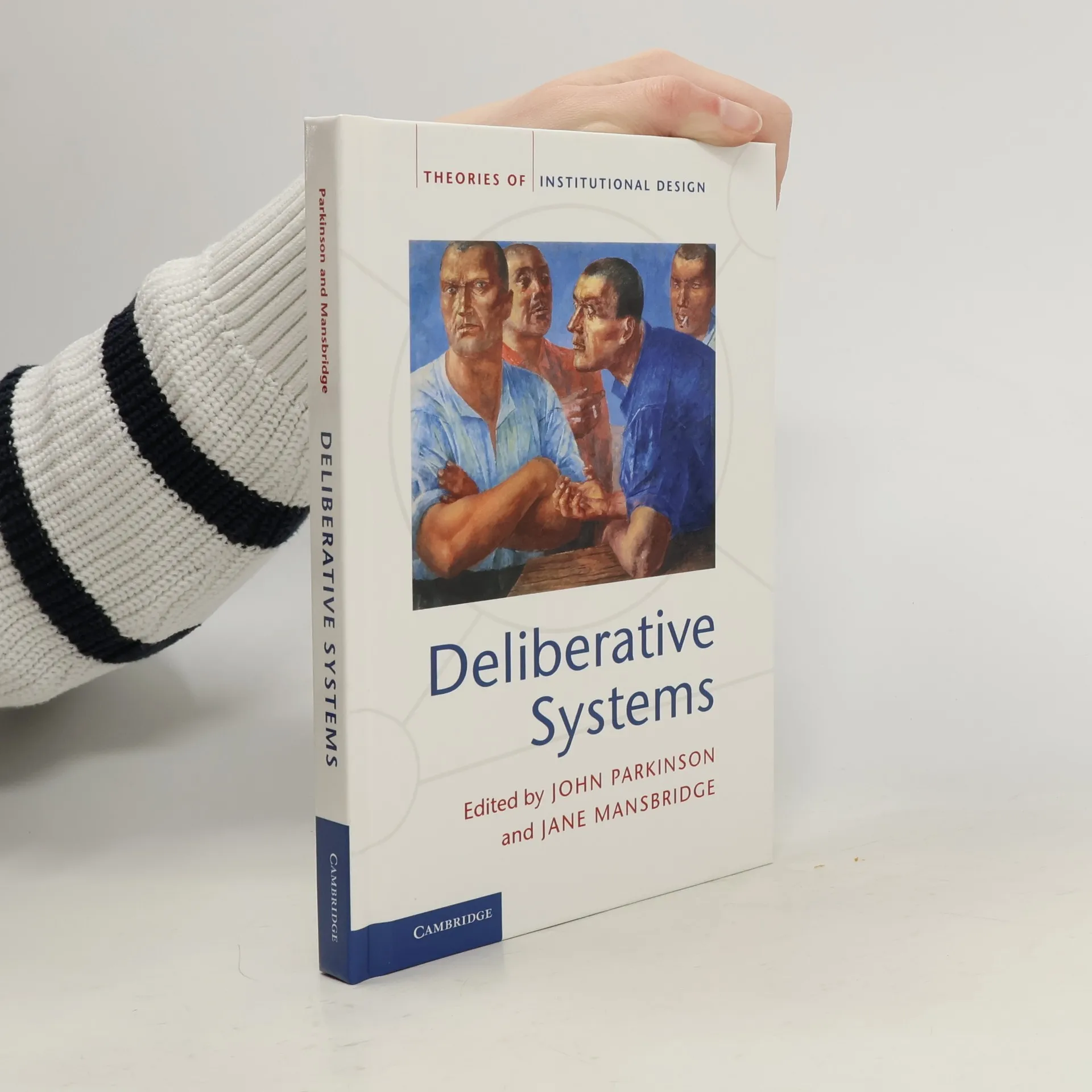
'Deliberative democracy' is often dismissed as a set of small-scale, academic experiments. This volume seeks to demonstrate how the deliberative ideal can work as a theory of democracy on a larger scale. It provides a new way of thinking about democratic engagement across the spectrum of political action, from towns and villages to nation states, and from local networks to transnational, even global systems. Written by a team of the world's leading deliberative theorists, Deliberative Systems explains the principles of this new approach, which seeks ways of ensuring that a division of deliberative labour in a system nonetheless meets both deliberative and democratic norms. Rather than simply elaborating the theory, the contributors examine the problems of implementation in a real world of competing norms, competing institutions and competing powerful interests. This pioneering book will inspire an exciting new phase of deliberative research, both theoretical and empirical.
John Parkinson Bücher
Die Werke dieses Autors bieten ein fesselndes und immersives Leseerlebnis, das die Leser in Welten voller thematischer Tiefe und meisterhafter Erzählkunst entführt. Ihre Schriften zeichnen sich durch eine tiefgründige Auseinandersetzung mit der menschlichen Verfassung aus, wobei oft universelle Wahrheiten durch eine einzigartige Perspektive beleuchtet werden. Der Stil des Autors ist sowohl ausgefeilt als auch zugänglich, was es den Lesern ermöglicht, sich leicht mit der Komplexität der präsentierten Erzählungen auseinanderzusetzen. Mit der Fähigkeit, starke Emotionen hervorzurufen und zum Nachdenken anzuregen, hat sich dieser Schriftsteller als eine bedeutende Stimme in der zeitgenössischen Literatur etabliert.


Explains how companies can productively use development effectiveness, an offshoot of total quality management, to ease problems regarding changing technologies in the information services organization by providing tools for change while still creating high-performance IS organizations. Contains proven implementation steps for planning and managing IT transitional processes along with the instruments relevant to measure the IS organization's current position, readiness for and ability to change.
60 Minute Software
Strategies for Accelerating the Information Systems Delivery Process
- 302 Seiten
- 11 Lesestunden
60 Minute Proven solutions for software developers and MIS professionals . The latest volume in the revolutionary Ernst & Young Information Management Series provides an in-depth examination of a key issue concerning IS cycle time compression in the development of business software—and its impact on the ability of businesses to meet new customer, product, or market requirements. Based on a three-year study by Ernst & Young's Center for Business Transformation, 60 Minute Software offers a variety of practical solutions that can be implemented quickly and efficiently. Acceleration strategies that have been used by such companies as Ameritech, IBM, and Hewlett Packard, among others, are analyzed in-depth. The results are of vital importance in light of the increasing demands on IS professionals in a technology-driven environment. 60 Minute Software