Collaborative Networks: Reference Modeling works to establish a theoretical foundation for Collaborative Networks. Particular emphasis is put on modeling multiple facets of collaborative networks and establishing a comprehensive modeling framework that captures and structures diverse perspectives of these complex entities. Further, this book introduces a contribution to the definition of reference models for Collaborative Networks. Collaborative Networks: Reference Modeling provides valuable elements for researchers, PhD students, engineers, managers, and leading practitioners interested in collaborative systems and networked society.
IFIP TC 5 / WG 5.5. Sixth IFIP International Conference on Information Technology for Balanced ... and Communication Technology, 159)
537 Seiten
19 Lesestunden
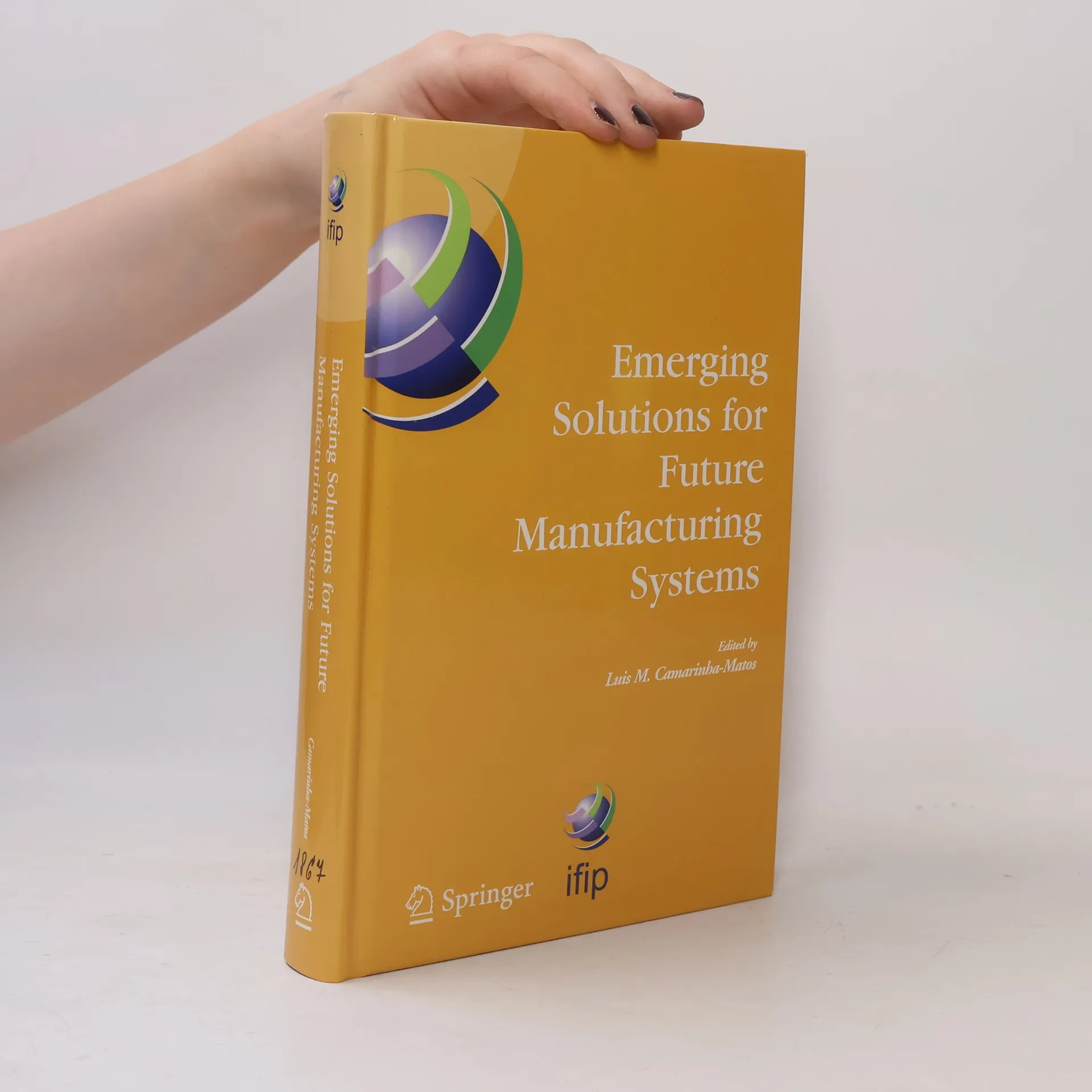
Industries and particularly the manufacturing sector have been facing difficult challenges in a context of socio-economic turbulence characterized by complexity as well as the speed of change in causal interconnections in the socio-economic environment. In order to respond to these challenges companies are forced to seek new technological and organizational solutions. In this context two main characteristics emerge as key properties of a modern automation system – agility and distribution. Agility because systems need not only to be flexible in order to adjust to a number of a-priori defined scenarios, but rather must cope with unpredictability. Distribution in the sense that automation and business processes are becoming distributed and supported by collaborative networks. Emerging Solutions for Future Manufacturing Systems includes the papers selected for the BASYS’04 conference, which was held in Vienna, Austria in September 2004 and sponsored by the International Federation for Information Processing (IFIP).
Virtual Organizations, Balanced Automation, and Systems Integration
504 Seiten
18 Lesestunden
New market trends and the emergence of the so-called Internet-based `new economy' are leading companies to new forms of organization, mostly relying on privileged cooperation links. Nowadays, most manufacturing processes are not carried out by single enterprises. Rather, organizations feel the need to focus on their core competencies and join efforts with others, in order to fulfill the requirements of new products/services demanded by the global market. In a cooperative networked organization, every enterprise is just a node that adds some value to the process; namely, a step in the manufacturing/supply chain. Furthermore, manufacturing companies increasingly encompass what has typically been regarded as the domain of the service sector. They try to establish long-term relationships with their customers, in order to service their needs around a manufactured product. For these reasons, the area of virtual organizations and industrial virtual enterprises is attracting growing interest in terms of research and development, and implementation approaches for new business practices.The main emphasis of this book is on virtual enterprises and other networked organizations, with special focus supporting infrastructures and management of distributed business processes, intelligent multi-agent systems, knowledge management, human interfaces, and socio-economical aspects. Also included in the book are related topics on automation, both in manufacturing and transportation. Special attention is assigned to the fact that advances in information technology and new organizational paradigms will be used not only to induce new economic structures, but also to help a sustainable migration of existing systems towards the new economy. When electronic business initiatives attract such widespread attention, it is important to conciliate the `old' and `new' economies under a balanced perspective.Advances in Networked Enterprises is essential reading for researchers and engineering students in production engineering, computer science, electrical engineering, mechanical engineering, industrial sociology, and transportation, as well as for engineers and practitioners in manufacturing and transportation systems organization and planning.