

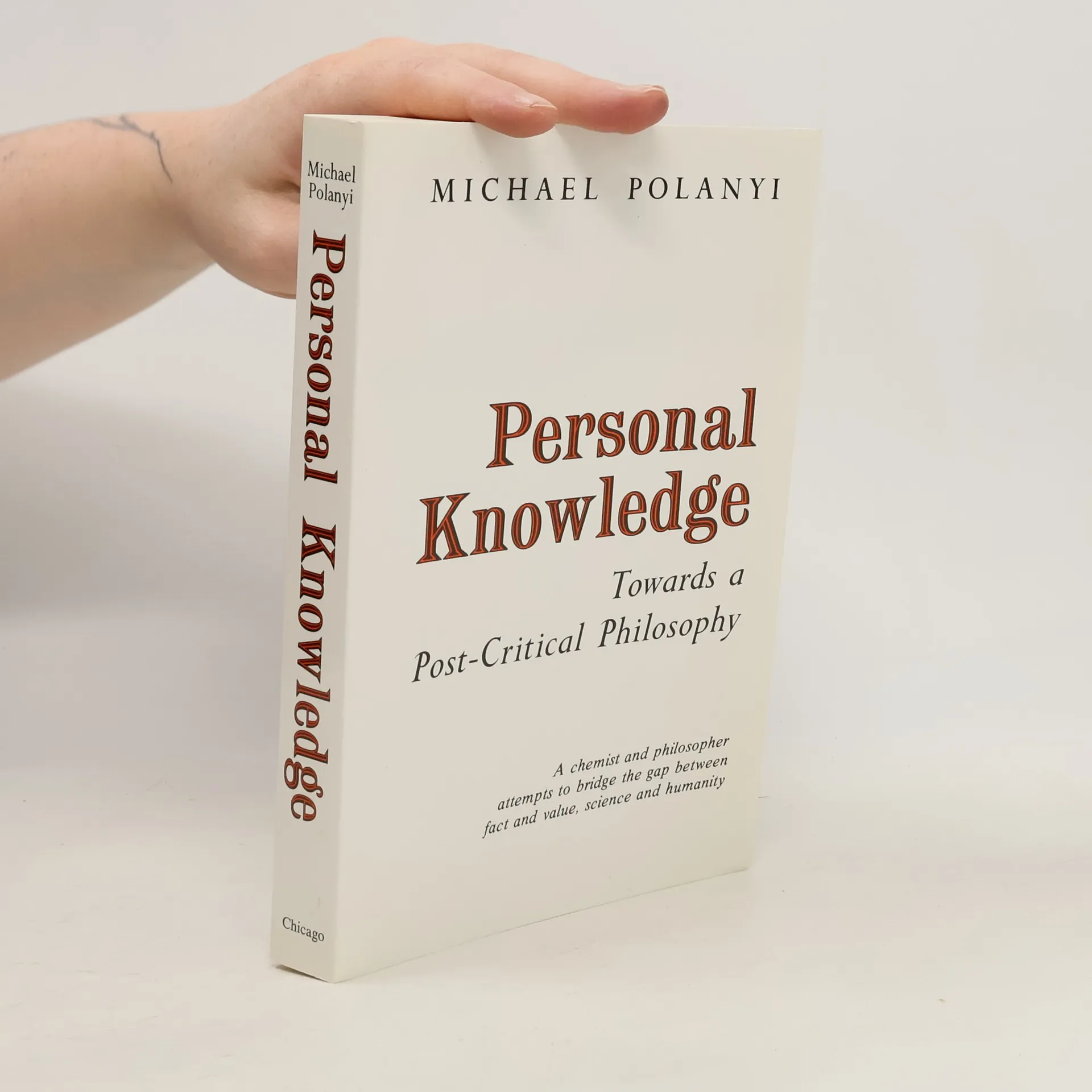


Personal Knowledge. Towards a Post-Critical Philosophy
Autor*innen
Buchbewertung
Mehr zum Buch
Books on epistemology tend to be dreary affairs. Epistemology, which is the branch of philosophy that studies how human beings acquire and "validate" their knowledge, tend to be largely speculative and logical. Most theories of epistemology that are inflicted upon the world are nothing more than highly artificial constructions of some philosopher's speculations as to how men "ought" to attain and validate their knowledge. Any correspondence to how men really attain knowledge is usually pure coincidence. Moreover, in many instances, the epistemological philosopher has some special agenda which he is seeking to impose on his readers by confusing them with a mass of epistemological pedantry. He may be trying to prove the validity of a largely speculative form of "reason" or of definitions or of certainty or of a perfect a immaculate form of "objectivity" or of some other equally utopian and irrelevant principle

Buchkauf
Personal Knowledge. Towards a Post-Critical Philosophy, Michael Polanyi
- Sprache

- Erscheinungsdatum
- 1974
- Einband
- (Paperback)
Hier könnte deine Bewertung stehen.
- Titel
- Personal Knowledge. Towards a Post-Critical Philosophy
- Sprache
- Englisch
- Autor*innen
- Michael Polanyi
- Erscheinungsdatum
- 1974
- Einband
- Paperback
- Seitenzahl
- 442
- ISBN10
- 0226672883
- ISBN13
- 9780226672885
- Reihe
- Kategorien
- Schlagwörter
- Psychologische Thematik, Philosophisches Thema, Wissenschaft, Bildung
- Bewertung
- 4,25 von 5 Sternen
- Beschreibung
- Books on epistemology tend to be dreary affairs. Epistemology, which is the branch of philosophy that studies how human beings acquire and "validate" their knowledge, tend to be largely speculative and logical. Most theories of epistemology that are inflicted upon the world are nothing more than highly artificial constructions of some philosopher's speculations as to how men "ought" to attain and validate their knowledge. Any correspondence to how men really attain knowledge is usually pure coincidence. Moreover, in many instances, the epistemological philosopher has some special agenda which he is seeking to impose on his readers by confusing them with a mass of epistemological pedantry. He may be trying to prove the validity of a largely speculative form of "reason" or of definitions or of certainty or of a perfect a immaculate form of "objectivity" or of some other equally utopian and irrelevant principle