


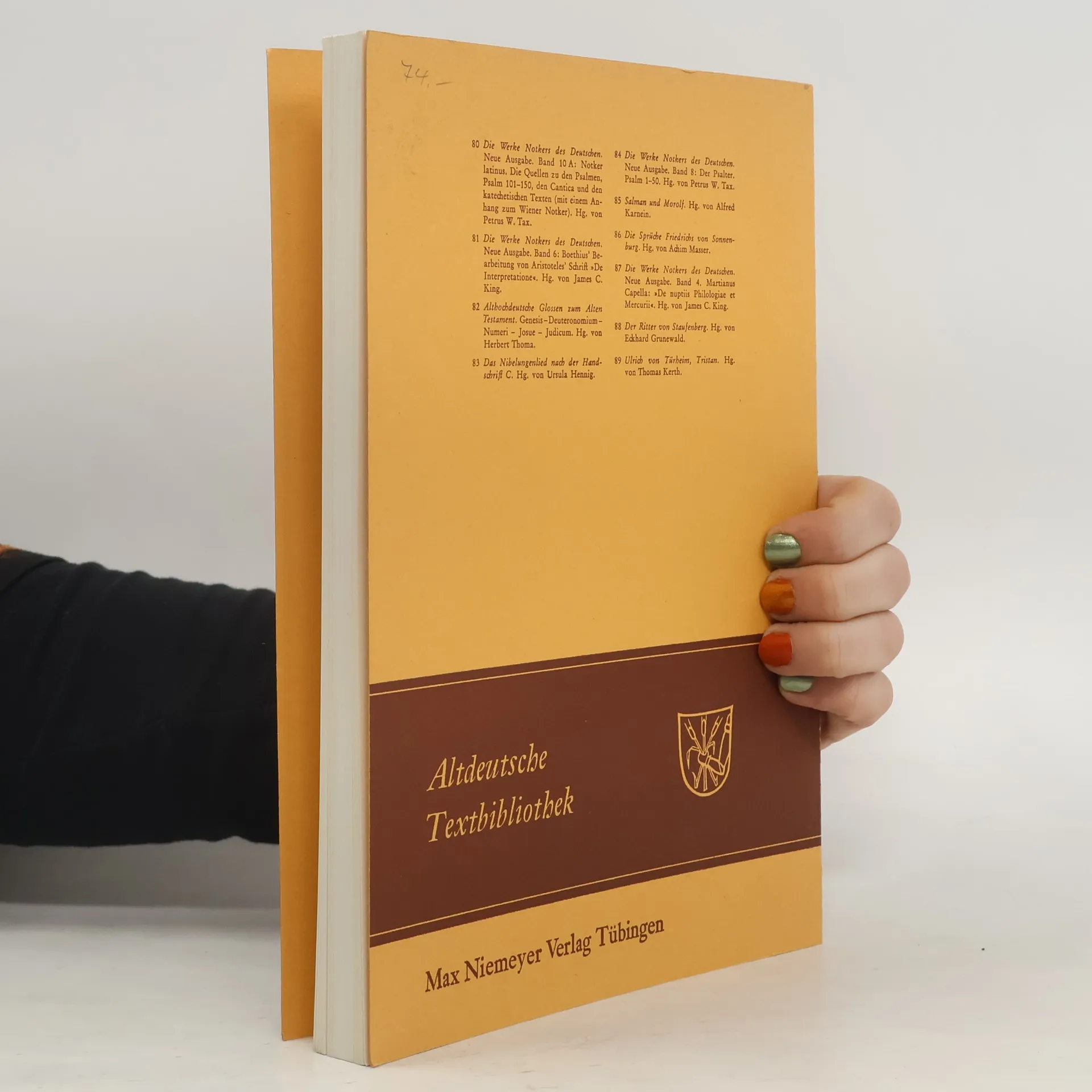

Altdeutsche Textbibliothek - 90: Die deutsche Sphaera
Mehr zum Buch
The Altdeutsche Textbibliothek [Old German Text Library] is the series of editions of German medieval texts with the richest history. Founded in 1881 by Hermann Paul, it has been edited by leading Germanists - Georg Beasecke, Hugo Kuhn, Burghart Wachinger. Since 2001, responsibility for the series has rested with Christian Kiening. In the meantime, the series comprises some 120 volumes, with an exemplary combination of closeness to the original manuscript(s) with ease of reading, philological accuracy with concern for university teaching. It includes recognised editions of "classical" authors from around 1200 - some with commentary - but also presents veritable editions of authors' works (Notker the German) and high-quality new editions (Eckenlied, Heinrich von dem Tuuuml;rlin).
Buchkauf
Altdeutsche Textbibliothek - 90: Die deutsche Sphaera, Conrad Heinfogel, Francis B. Brévart, Joannes De Sacro Bosco, von Megenberg Konrad
- Sprache


- Erscheinungsdatum
- 1980
- Einband
- (Paperback)
Keiner hat bisher bewertet.
- Titel
- Altdeutsche Textbibliothek - 90: Die deutsche Sphaera
- Sprache
- Deutsch, Lateinisch
- Verlag
- De Gruyter
- Erscheinungsdatum
- 1980
- Einband
- Paperback
- Seitenzahl
- 197
- ISBN10
- 3484201096
- ISBN13
- 9783484201095
- Reihe
- Schlagwörter
- Deutsche Literatur, Deutschland, Weltraum, Mittelalter, Literarische Kritik
- Beschreibung
- The Altdeutsche Textbibliothek [Old German Text Library] is the series of editions of German medieval texts with the richest history. Founded in 1881 by Hermann Paul, it has been edited by leading Germanists - Georg Beasecke, Hugo Kuhn, Burghart Wachinger. Since 2001, responsibility for the series has rested with Christian Kiening. In the meantime, the series comprises some 120 volumes, with an exemplary combination of closeness to the original manuscript(s) with ease of reading, philological accuracy with concern for university teaching. It includes recognised editions of "classical" authors from around 1200 - some with commentary - but also presents veritable editions of authors' works (Notker the German) and high-quality new editions (Eckenlied, Heinrich von dem Tuuuml;rlin).