

Gratisversand in ganz Deutschland!
Bookbot

Dayanita Singh

    Bawa Chairs
    Sea of Files
    Sent a letter
    Book Building
    File room
    Dayanita Singh, go away closer
    • Dayanita Singh, go away closer

      • 32 Seiten
      • 2 Lesestunden
      5,0(2)Abgeben

      Go Away Closer is a novel without words. It concerns series of opposites in Singh's India: presence and absence, reality and dreams, tradition and progress. She is able to express the emotion underlying these often abstract concepts, because her photography springs from her own intimate experiences. For example, Singh establishes a connection between her personal losses, and the collective sadness due to lost traditions in the face of technology. Such opposites are ultimately irreconcilable, as embodied by the paradox of the book's title. Singh embraces this uncertainty, and presents visual clues in her photographs into which the viewer can read his or her own biography. Go Away Closer - like all Singh's books- is not about answering questions, but considering the emotion fabric from which they arise.

      Dayanita Singh, go away closer
    • File room

      • 160 Seiten
      • 6 Lesestunden
      4,5(6)Abgeben

      Dayanita Singh’s File Room is an elegy to paper in the age of the digitization of information and knowledge. The analogue photographer and bookmaker has a unique relationship with paper that is integral not only to the work of making of images, texts and memory, but also to a larger confrontation with chaos, mortality and disorder in the labyrinths of working bureaucratic archives in a country of more than a billion people. The endless rows of files in Indian courts, municipal offices, state archives and other such institutions for the conservation of human data create monuments to knowledge and to the arts of memory. They have their own atmosphere and architecture, rooted both in history and in the present. Archivists spend their lives organizing and conserving these forests of paper; historians and scholars forage in them for voices from the past; and the lives of ordinary men and women get entangled in the bureaucratic and litigious systems with their own copiousness of paperwork and files. Including an interview with Hans Ulrich Obrist that relates this book with Singh’s other books and bodies of work, and texts by Aveek Sen that explore the different ways in which the mad world of files and paperwork continue to touch ordinary lives, File Room is itself an archive of archives. It documents, and reflects on, the nature of paper as material and symbol in the work of making photographs and books.

      File room
    • Book Building

      • 136 Seiten
      • 5 Lesestunden
      4,0(2)Abgeben

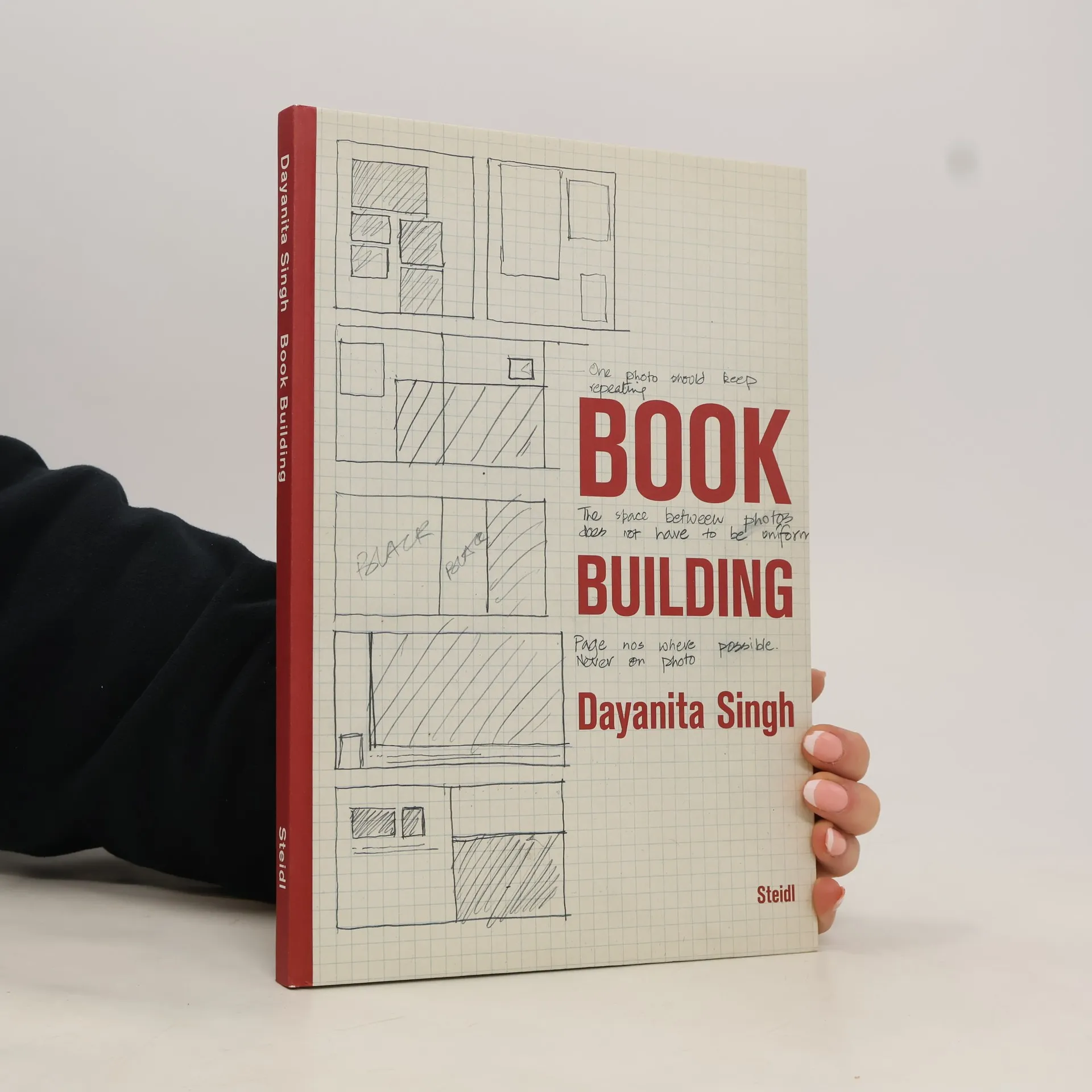
      Exploring the innovative concept of a book as an evolving art form, this work showcases Dayanita Singh's journey from her first publication to her recent creations. It highlights her unique approach to transforming books into multi-dimensional objects that challenge traditional definitions. The narrative details her collaboration with Gerhard Steidl, illustrating how Singh's works, such as Museum of Chance, have transitioned through various formats. Accompanied by images and DIY instructions, readers are invited to engage with her art, becoming curators of their own exhibitions.

      Book Building
    • Dayanita Singh has been making small photo journals of her travels in India for some years now. Each book is made with a certain person in mind, either one she has made the journey with or one that was on her mind during her travels. She makes two copies of each book by hand, one of which remains with her, and the other of which goes to the friend it was made for. A diary with coded images of a time shared. Steidl is pleased to publish seven of these small journals for the first time, along with an eighth journal of her mother, Nony Singh's, photographs of her daughter growing up. The journals are produced in accordion folds so that they can open into mini private exhibitions in her friends' homes, and come housed in a handmade wooden box.

      Sent a letter
    • Sea of Files

      Hasselblad Award 2022

      • 156 Seiten
      • 6 Lesestunden

      Focusing on the theme of archives, this book highlights Dayanita Singh's innovative approach to photography, celebrating her as the 2022 Hasselblad Award winner. It features her visual essay "Sea of Files" and introduces "Museum of Innocence (The Madras Chapter)," showcasing her exploration of cultural experience and memory. Nobel Laureate Orhan Pamuk contributes a personal essay reflecting on the emotional depth of Singh's work, which blends humanist portraiture with inventive display methods, challenging conventional museum and publishing paradigms.

      Sea of Files
    • Exploring the interplay between architecture and furniture, this work features photographs of chairs found in spaces designed by the influential South Asian architect Geoffrey Bawa. Each chair is portrayed with distinct personalities, reflecting Singh's view of them as more than mere objects. Celebrating Bawa's centenary, the book is designed as an accordion-fold booklet, allowing readers to engage with the content in a curatorial manner, transforming the experience into an interactive exhibition.

      Bawa Chairs
    • "Let’s See" is a photo-novel by Dayanita Singh, reflecting on her early years as a photographer. It showcases previously unseen images from the 1980s and ’90s, capturing moments with friends, family, and significant figures in her life. Singh emphasizes the theme of perception and the unique vision of the camera.

      Let's See
    • A three-part portrait of working conditions and the imagery of industry in India This book is Dayanita Singh's (born 1961) meditative, sometimes melancholic exploration of work environments across India. Each of its three visual chapters springs from larger individual series in Singh's archive which she has now reedited around the theme of work. The first series, Museum of Machines, presents black-and-white images of factory equipment, stately despite its grime, and only occasionally joined by human counterparts. Blue Book shows photographs of industrial landscapes Singh made on her wanderings--atypically in color, the serendipitous outcome of running out of black-and-white film--which form a poetic critique of the sites of labor. Go Away Closer returns us to black and white, and reveals the greatest range of subjects, from thousands of scooters in a warehouse to the charming clutter of a shop, and are taken from a series Singh originally edited according to what she calls the "note and feeling" of the images.

      Work in Process
    • Dayanita Singh has long photographed the intriguing cloth bundles of India’s archives, yet Time Measures marks the first time she has made portraits of them. Unlike its sister book Pothi Khana, which shows such bundles within their environments (on overflowing shelves, in the practiced hands of archivists), Time Measures presents these treasures photographed individually and close-up against a neutral stone background. Their details are thus revealed: the unique sun-bleached patterns in red, green or blue, the varying shapes and knots (tied and re-tied over the decades by unseen hands), the outlines of the secret contents within (which remain unknown even to Singh herself). Her images invite a process of slow, attentive looking through which the bundles assume the weathered charm of people’s faces; the series becomes a shifting taxonomy of portraits. Bound in three different covers and designed to be hung directly on the wall, Time Measures furthermore extends Singh’s project of transforming the book into the exhibition.

      Time Measures
    • Dayanita Singh's photos of archives and their custodians across India examine how memory is made and how history is narrated. These images bring to light the paradox of archives: they are impersonal in their classifications, yet each is the careful handiwork of an individual archivist, an unsung keeper of history whose decisions generate the sources of much of our knowledge. Archives are vessels of orthodox fact but can also be the home of neglected details and forgotten documents than can unfix the status quo. As the pace of change in contemporary India accelerates and Indians turn from the past and fix their gaze on the future, what will become of the archive? Singh prompts us to imagine archives as not merely documents of dusty scholarship but as monuments of knowledge, beautiful in their unkempt order.

      File Room (2023)