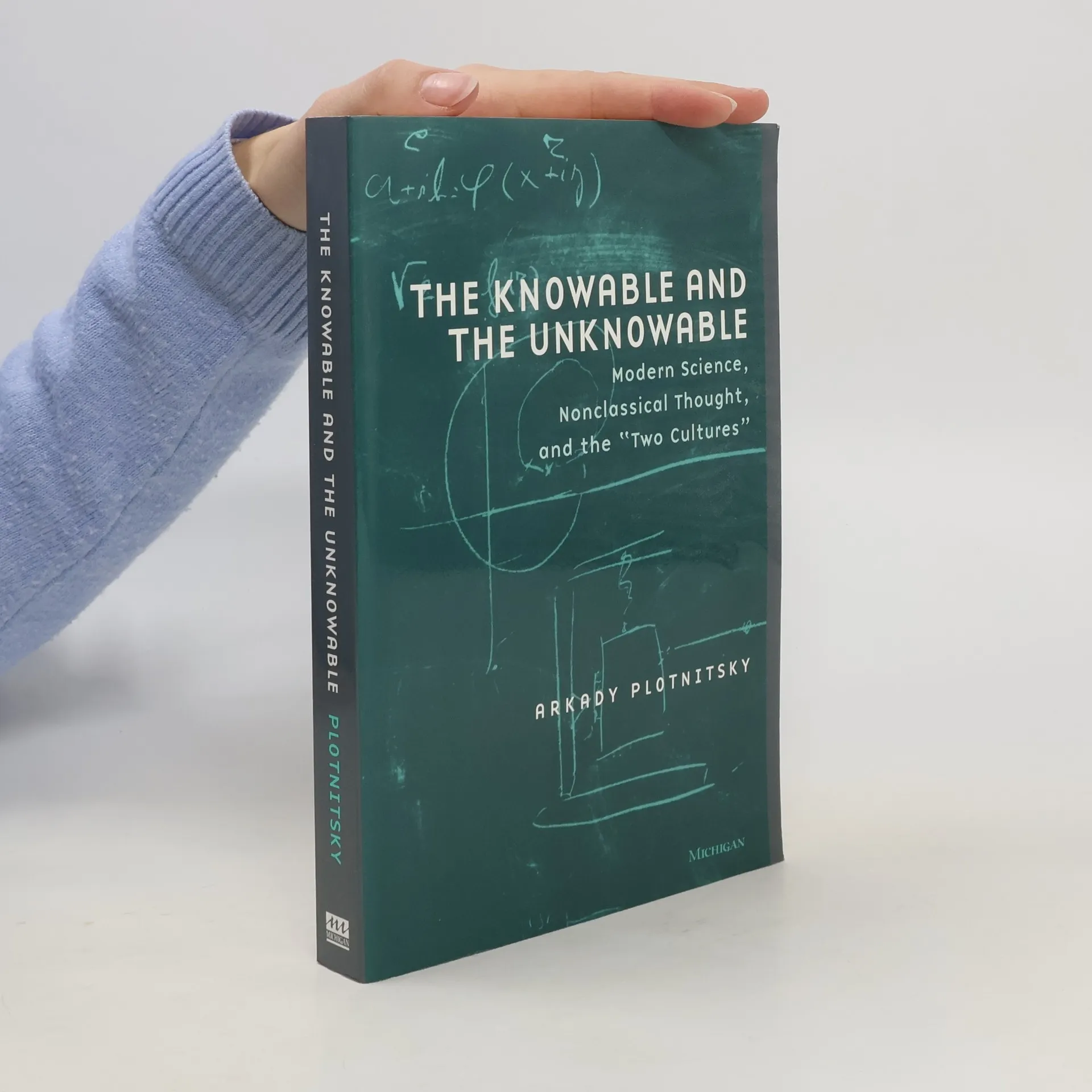
The Knowable and the Unknowable
- 319 Seiten
- 12 Lesestunden





Bohr, Heisenberg, Schrödinger, and the Nature of Quantum-Theoretical Thinking
The book delves into the intricate connections between epistemology and probability within the realm of quantum mechanics, examining the contributions of key physicists like Bohr, Heisenberg, and Schrodinger. It highlights the profound and often contentious implications of these relationships, offering insights into how they shape our understanding of physics as a discipline.
The Nature of Quantum Reality and the Spirit of Copenhagen
Focusing on foundational thinking in quantum theory, the book explores the significance of fundamental principles and principle thinking, which have driven major breakthroughs from the early quantum theory to contemporary quantum information theory. It revisits the contributions of key figures like Einstein and Bohr, offering a new interpretation of quantum mechanics known as "the statistical Copenhagen interpretation." The work emphasizes the historical and philosophical evolution of quantum theory, highlighting the essential shifts in understanding reality, probability, and locality that define its foundational principles.
"Reading Bohr: Physics and Philosophy" offers a fresh perspective on Niels Bohr's quantum mechanics interpretation as complementarity, exploring its philosophical implications and the Bohr-Einstein debates. It emphasizes key developments in Bohr's thought, especially regarding quantum field theory, enhancing our understanding of quantum physics history.
Many commentators have remarked in passing on the resonance between deconstructionist theory and certain ideas of quantum physics. In this book, Arkady Plotnitsky rigorously elaborates the similarities and differences between the two by focusing on the work of Niels Bohr and Jacques Derrida. In detailed considerations of Bohr's notion of complementarity and his debates with Einstein, and in analysis of Derrida's work via Georges Bataille's concept of general economy, Plotnitsky demonstrates the value of exploring these theories in relation to each other.Bohr's term complementarity describes a situation, unavoidable in quantum physics, in which two theories thought to be mutually exclusive are required to explain a single phenomenon. Light, for example, can only be explained as both wave and particle, but no synthesis of the two is possible. This theoretical transformation is then examined in relation to the ways that Derrida sets his work against or outside of Hegel, also resisting a similar kind of synthesis and enacting a transformation of its own.Though concerned primarily with Bohr and Derrida, Plotnitsky also considers a wide range of anti-epistemological endeavors including the work of Nietzsche, Bataille, and the mathematician Kurt Gödel. Under the rubric of complementarity he develops a theoretical framework that raises new possiblilities for students and scholars of literary theory, philosophy, and philosophy of science
The book explores quantum theory through the lens of "reality without realism" (RWR), emphasizing new relationships among matter, thought, and experimental technology. It examines the contributions of key figures like Bohr, Heisenberg, Schrödinger, and Dirac, aiming to merge the philosophy and history of quantum physics. The author argues that experimental technology fundamentally alters our understanding of physical phenomena, challenging traditional views from classical physics and relativity by highlighting the interconnectedness of matter, thought, and technology.
Focusing on Niels Bohr's groundbreaking concept of "complementarity," the book traces his intellectual journey from his 1913 atomic theory to the development and refinement of this pivotal idea. It explores various interpretations of complementarity, examining its connections to Bohr's other theories. The aim is to provide a clear and thorough understanding of Bohr's contributions to both physics and philosophy, highlighting the significance of his work in a manner that is accessible yet comprehensive.
Thinkable and the Unthinkable in Mathematics, from the Pythagoreans to the Moderns
Exploring the philosophical dimensions of mathematics, this study delves into two key aspects: the conceptual nature of mathematics as an invention of ideas, and a Pythagorean perspective that highlights the relationship between geometry and algebra. It traces these ideas from ancient Greek mathematics to modern developments, particularly focusing on radical Pythagorean mathematics, which examines the interplay of thought and the ineffable in mathematical reasoning. Aimed at mathematicians, physicists, and scholars, it offers a fresh historical and philosophical understanding of mathematics.