

Johann Pfanzagl Bücher



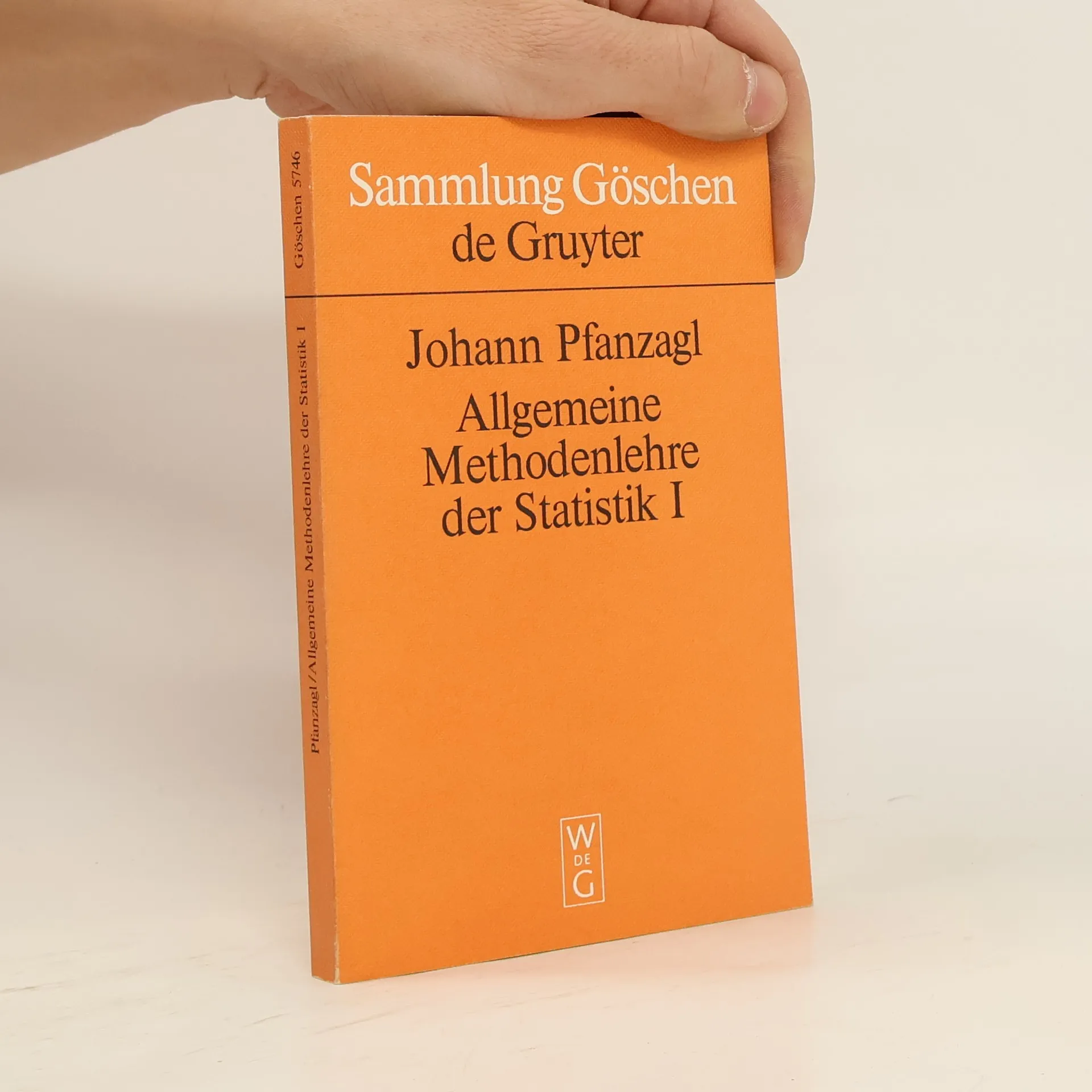


Allgemeine Methodenlehre der Statistik
- 268 Seiten
- 10 Lesestunden
Elementare Wahrscheinlichkeitsrechnung
- 313 Seiten
- 11 Lesestunden
Lecture Notes in Statistics - 13: Contributions to a General Asymptotic Statistical Theory
- 315 Seiten
- 12 Lesestunden
The aso theory developed in Chapters 8 - 12 presumes that the tan- gent cones are linear spaces. In the present chapter we collect a few natural examples where the tangent cone fails to be a linear space. These examples are to remind the reader that an extension of the theo- ry to convex tangent cones is wanted. Since the results are not needed in the rest of the book, we are more generous ab out regularity condi- tions. The common feature of the examples is the Given a pre- order (i.e., a reflexive and transitive order relation) on a family of p-measures, and a subfamily i of order equivalent p-measures, the fa- mily consists of p-measures comparable with the elements of i. This usually leads to a (convex) tangent cone 1f only p-measures larger (or smaller) than those in i are considered, or to a tangent co ne con- sisting of a convex cone and its reflexion about 0 if both smaller and larger p-measures are allowed. For partial orders (i.e., antisymmetric pre-orders), ireduces to a single p-measure. we do not assume the p-measures in to be pairwise comparable.
Springer Series in Statistics: Mathematical Statistics
Essays on History and Methodology
- 326 Seiten
- 12 Lesestunden
This book presents a detailed description of the development of statistical theory. In the mid twentieth century, the development of mathematical statistics underwent an enduring change, due to the advent of more refined mathematical tools. New concepts like sufficiency, superefficiency, adaptivity etc. motivated scholars to reflect upon the interpretation of mathematical concepts in terms of their real-world relevance. Questions concerning the optimality of estimators, for instance, had remained unanswered for decades, because a meaningful concept of optimality (based on the regularity of the estimators, the representation of their limit distribution and assertions about their concentration by means of Anderson’s Theorem) was not yet available. The rapidly developing asymptotic theory provided approximate answers to questions for which non-asymptotic theory had found no satisfying solutions. In four engaging essays, this book presents a detailed description of how the use of mathematical methods stimulated the development of a statistical theory. Primarily focused on methodology, questionable proofs and neglected questions of priority, the book offers an intriguing resource for researchers in theoretical statistics, and can also serve as a textbook for advanced courses in statisticc.
