Serge Lang Bücher





InhaltsverzeichnisWomit beschäftigt sich ein reiner Mathematiker und warum? Primzahlen.Ein lebendiges Tun: Mathematik betreiben Diophantische Gleichungen.Große Probleme der Geometrie und des Raumes.
World-Cup
Ski-Faszination seit 1967: Sport und Geschichte des World-Cup mit mehr als 150 fantastischen Farbbildern
- 185 Seiten
- 7 Lesestunden
This calculus textbook aims to introduce students to the fundamental concepts of derivatives and integrals, balancing accessibility with necessary technical exercises. It is designed for beginners rather than advanced mathematicians, providing a pleasant learning experience while maintaining essential rigor in the subject matter.
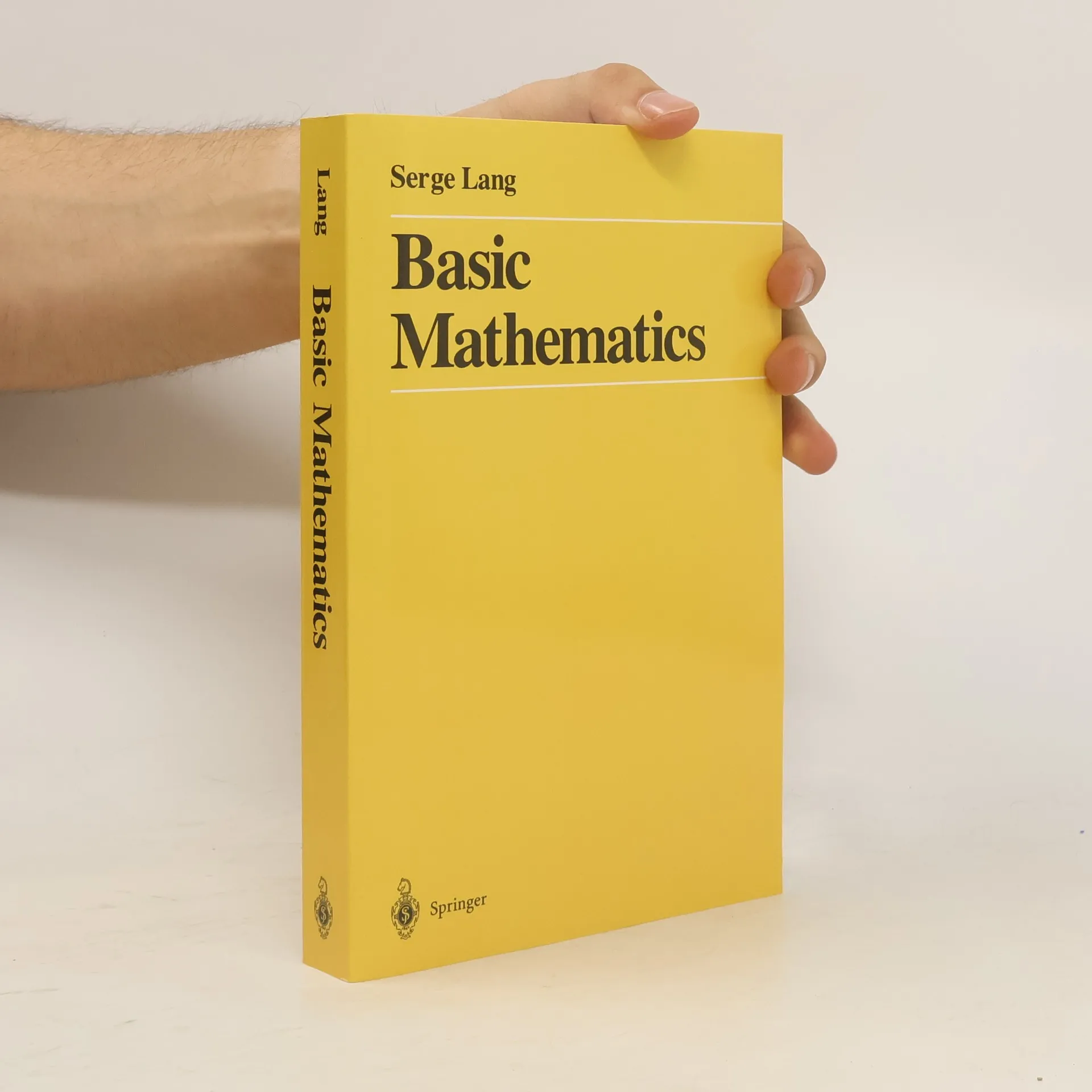
This text in basic mathematics is ideal for high school or college students. It provides a firm foundation in basic principles of mathematics and thereby acts as a springboard into calculus, linear algebra and other more advanced topics. The information is clearly presented, and the author develops concepts in such a manner to show how one subject matter can relate and evolve into another.
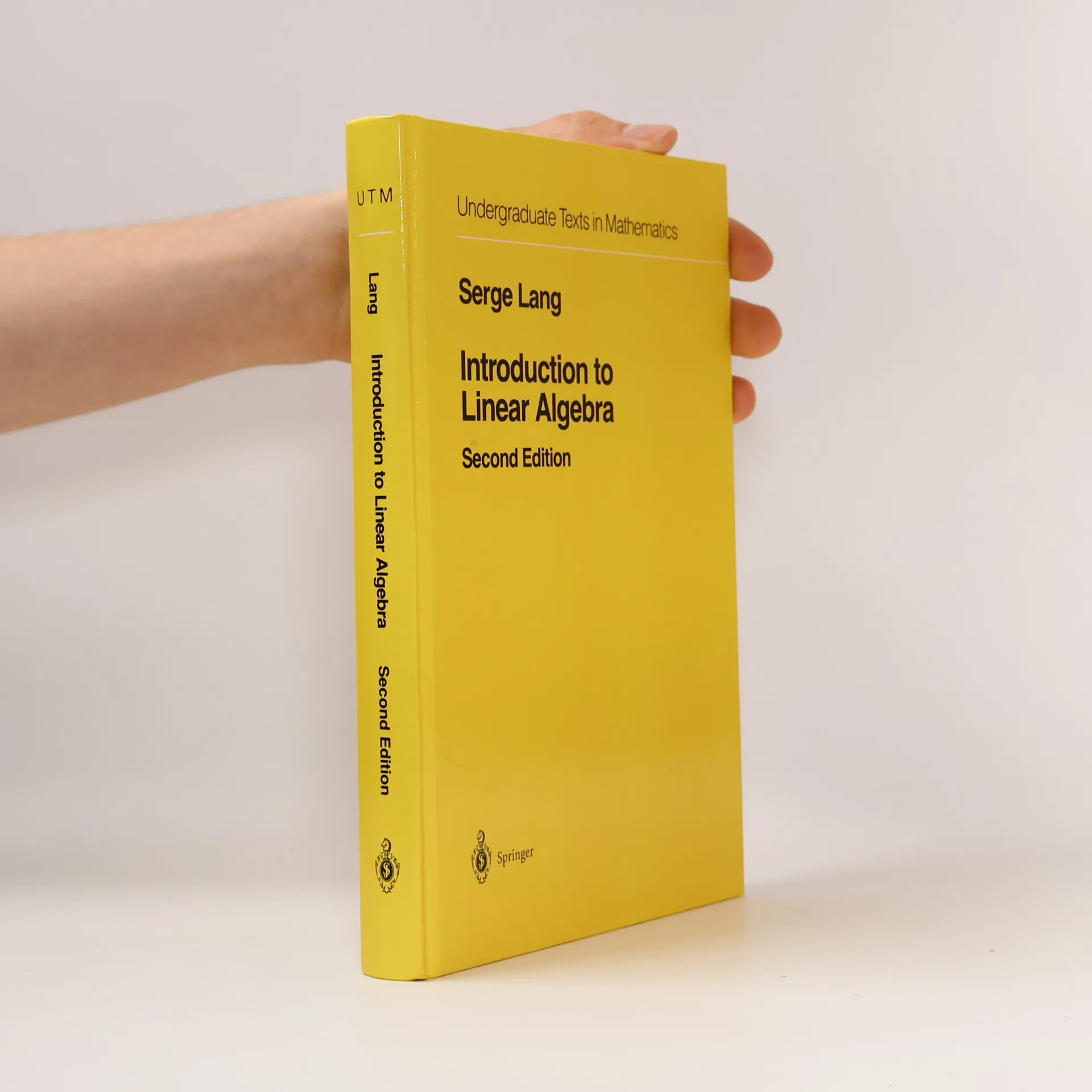
Undergraduate Texts in Mathematics: Introduction to Linear Algebra
Second Edition
- 308 Seiten
- 11 Lesestunden
This concise linear algebra text is designed for a one-term course. It explores the connection between geometry and algebra, covering topics like linear equations, matrices, vector spaces, and eigenvalues. The book features numerous exercises, ranging from routine computations to more conceptual challenges.
Author is well-known and established book author (all Serge Lang books are now published by Springer); Presents a brief introduction to the subject; All manifolds are assumed finite dimensional in order not to frighten some readers; Complete proofs are given; Use of manifolds cuts across disciplines and includes physics, engineering and economics
Introduction to Algebraic Geometry
- 274 Seiten
- 10 Lesestunden
Focusing on qualitative algebraic geometry, this book serves as an introduction to the Weil-Zariski framework, expanding on lectures from a series of courses initiated by Zariski. It provides a comprehensive overview of Weil's "Foundations" and contextualizes the development of modern algebraic geometry prior to the introduction of sheaves. This reprint preserves the original text, offering readers an authentic experience of the foundational concepts in the field.
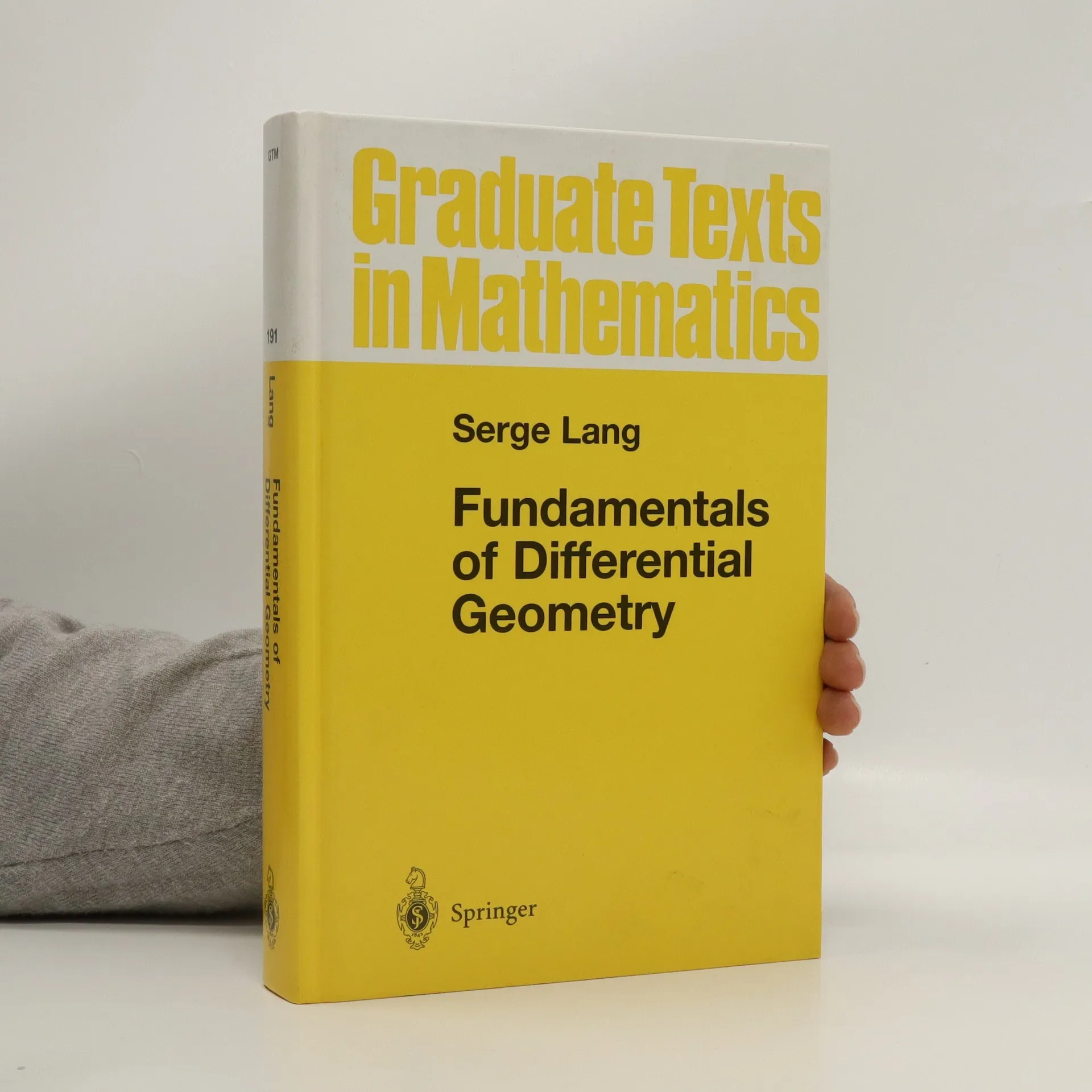
This book provides an introduction to the basic concepts in differential topology, differential geometry, and differential equations, and some of the main basic theorems in all three areas. This new edition includes new chapters, sections, examples, and exercises. From the reviews: "There are many books on the fundamentals of differential geometry, but this one is quite exceptional; this is not surprising for those who know Serge Lang's books." --EMS NEWSLETTER
Addison-Wesley Series in Mathematics - 4166: Differential Manifolds
- 230 Seiten
- 9 Lesestunden
The present volume supersedes my Introduction to Differentiable Manifolds written a few years back. I have expanded the book considerably, including things like the Lie derivative, and especially the basic integration theory of differential forms, with Stokes' theorem and its various special formulations in different contexts. The foreword which I wrote in the earlier book is still quite valid and needs only slight extension here. Between advanced calculus and the three great differential theories (differential topology, differential geometry, ordinary differential equations), there lies a no-man's-land for which there exists no systematic exposition in the literature. It is the purpose of this book to fill the gap. The three differential theories are by no means independent of each other, but proceed according to their own flavor. In differential topology, one studies for instance homotopy classes of maps and the possibility of finding suitable differentiable maps in them (immersions, embeddings, isomorphisms, etc.). One may also use differentiable structures on topological manifolds to determine the topological structure of the manifold (e.g. it la Smale [26]).
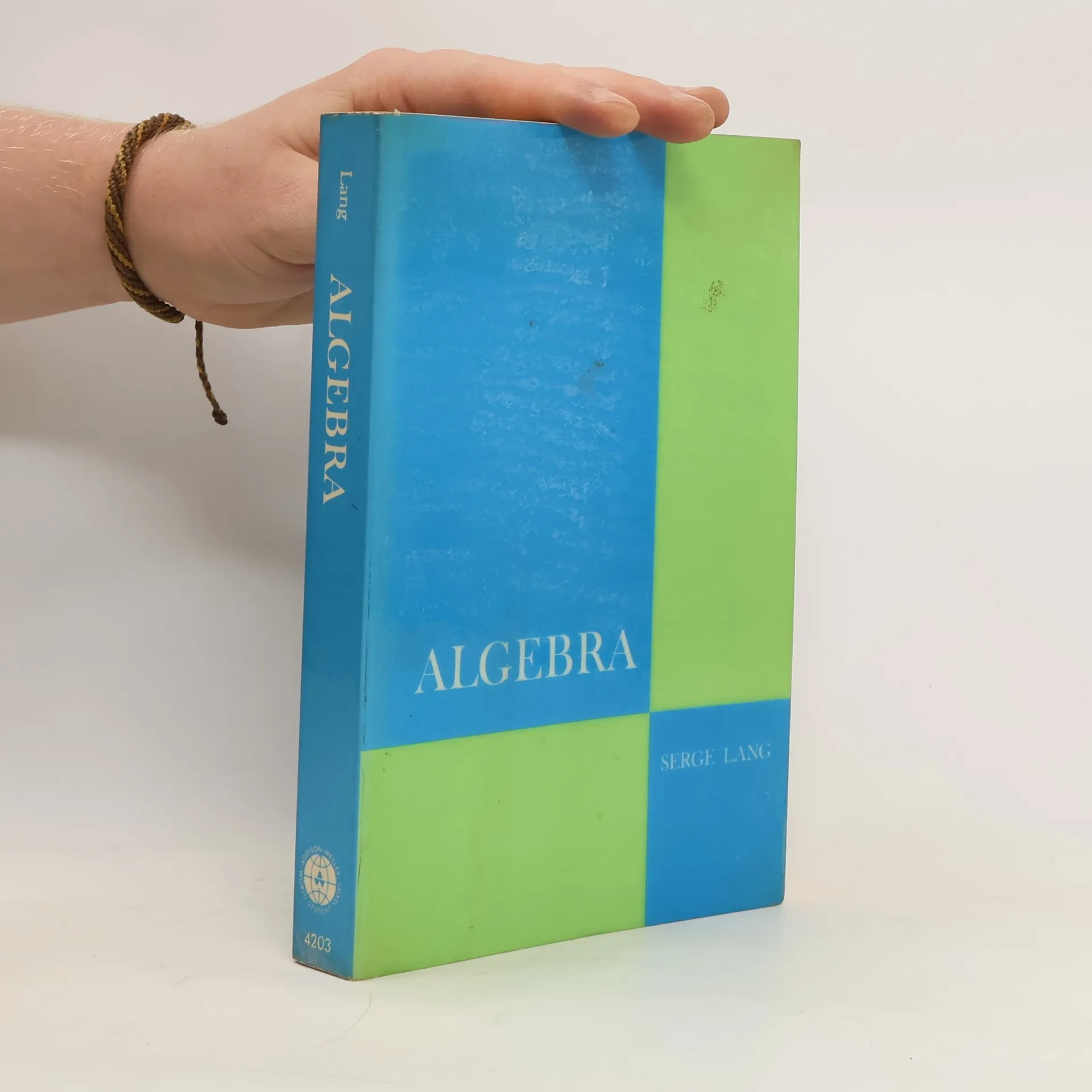
This book is intended as a basic text for a one year course in algebra at the graduate level or as a useful reference for mathematicians and professionals who use higher-level algebra. This book successfully addresses all of the basic concepts of algebra. For the new edition, the author has added exercises and made numerous corrections to the text. From MathSciNet's review of the first edition: "The author has an impressive knack for presenting the important and interesting ideas of algebra in just the "right" way, and he never gets bogged down in the dry formalism which pervades some parts of algebra."
Linear algebra
- 296 Seiten
- 11 Lesestunden
"Linear Algebra" is intended for a one-term course at the junior or senior level. It begins with an exposition of the basic theory of vector spaces and proceeds to explain the fundamental structure theorem for linear maps, including eigenvectors and eigenvalues, quadratic and hermitian forms, diagnolization of symmetric, hermitian, and unitary linear maps and matrices, triangulation, and Jordan canonical form. The book also includes a useful chapter on convex sets and the finite-dimensional Krein-Milman theorem. The presentation is aimed at the student who has already had some exposure to the elementary theory of matrices, determinants and linear maps. However the book is logically self-contained. In this new edition, many parts of the book have been rewritten and reorganized, and new exercises have been added.
Differential and Riemannian Manifolds
- 384 Seiten
- 14 Lesestunden
Focusing on fundamental concepts in differential topology, geometry, and equations, this expanded edition introduces three new chapters dedicated to Riemannian and pseudo-Riemannian geometry. It also features updated sections on sprays and Stokes' theorem, enriching the content for readers interested in advanced mathematical theories and applications.
Algebraic Number Theory
- 376 Seiten
- 14 Lesestunden
The book presents a comprehensive exploration of classical algebraic and analytic number theory, expanding on previous works to include class field theory. It emphasizes a global perspective while addressing local fields only briefly. The author integrates ideal and idelic approaches, offering two distinct proofs of the functional equation for the zeta function to showcase various techniques. The text references influential literature and highlights the enduring relevance of historical cases in advancing theoretical understanding.
The book is a mostly translated reprint of a report on cohomology of groups from the 1950s and 1960s, originally written as background for the Artin-Tate notes on class field theory, following the cohomological approach. This report was first published (in French) by Benjamin. For this new English edition, the author added Tate's local duality, written up from letters which John Tate sent to Lang in 1958 - 1959. Except for this last item, which requires more substantial background in algebraic geometry and especially abelian varieties, the rest of the book is basically elementary, depending only on standard homological algebra at the level of first year graduate students.