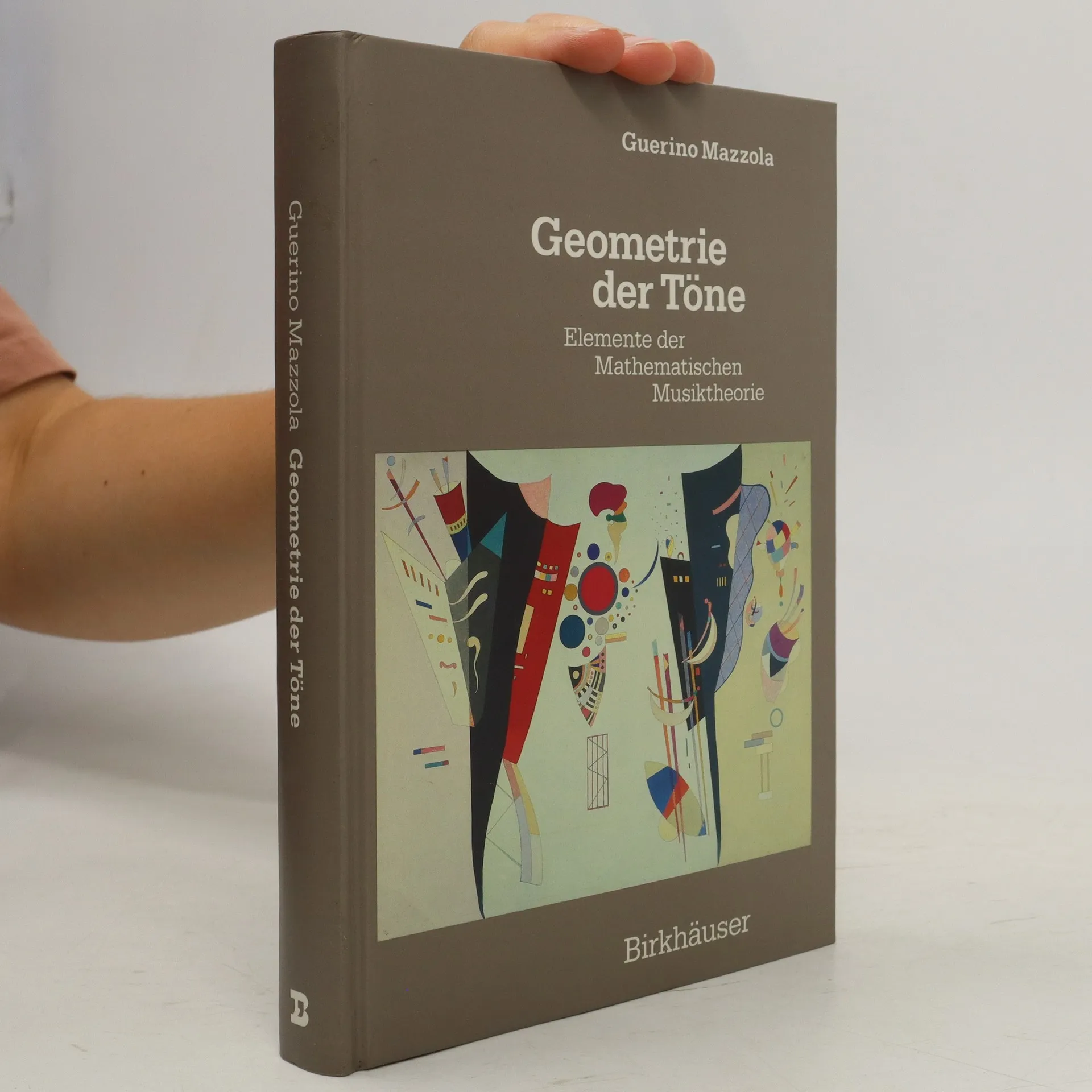
Geometrie der Töne
- 364 Seiten
- 13 Lesestunden


The second edition of this four-volume set delves into an innovative framework for understanding music through mathematical and theoretical lenses. Volume I introduces key concepts such as denotators, musical classifications, and mathematical models of harmony. Volume II explores musical performance using differential geometry and performance vector fields. Volume III focuses on gesture theory, linking it to music and physics, while Volume IV provides appendices that cover foundational topics in sound, mathematics, and music.
A Comprehensive Approach: Theory, Analytical Tools, and Case Studies
Exploring the landscape of modern performance, this book presents a foundational framework for understanding the discipline's evolution and potential. It delves into various forms of performance, emphasizing their cultural significance and the interplay between tradition and innovation. By examining key themes and practices, the author invites readers to consider the future of performance art in contemporary society, making it a thought-provoking resource for artists, scholars, and enthusiasts alike.
This book explores free jazz as a collaborative art form, highlighting artists like John Coltrane and Archie Shepp. It develops geometric theories of gestures and swarm intelligence, integrating insights from psychology, physics, and computer science to analyze the creative processes within free jazz.
Focusing on the theory of musical performance, this volume explores concepts through differential geometry, introducing performance vector fields that enhance understanding of tempo and intonation. It highlights the innovative Rubato software platform, which facilitates composition, analysis, and performance, allowing for experimental evaluation of expressive performance theories. This work aims to bridge theoretical concepts with practical applications in music.
The fourth volume of the second edition delves into the intricate relationship between music and mathematics, offering appendices that cover sound and auditory physiology. It includes foundational mathematical concepts like sets, relations, and algebraic geometry, alongside insights from physics, particularly string theory. Additionally, the book provides valuable tables detailing chord classes and modulation steps, making it a comprehensive resource for understanding the theoretical aspects of music.
Geometric Logic, Classification, Harmony, Counterpoint, Motives, Rhythm
The book delves into the conceptual framework of musical theory, focusing on denotators and forms. It classifies both local and global musical objects while exploring mathematical models related to harmony and counterpoint. Additionally, it examines topologies concerning rhythm and motives, making it a foundational text for understanding the intricate relationships within music theory. This first volume of the second edition enhances the classic work's insights into the mathematical underpinnings of music.