
The collection showcases Paulo Ribenboim's significant contributions to ordered structures and mathematical logic, featuring two unpublished papers and his first book on abelian groups. With over 240 publications, Ribenboim's influential research spans number theory, algebraic structures, and model theory, including collaborations with notable mathematicians. The volumes delve into topics such as algebraic structures on directed graphs and real algebraic geometry, reflecting his profound impact on the field. Ribenboim is a professor emeritus at Queen's University, with a prestigious prize named in his honor.
Paulo Ribenboim Reihenfolge der Bücher


- 2020
- 2016
PRIME NUMBERS, FRIENDS WHO GIVE PROBLEMS
- 336 Seiten
- 12 Lesestunden
The narrative unfolds as a dialogue between mathematician Papa Paulo and his grandsons, offering insights into prime numbers and the thought processes of mathematicians. Through engaging conversations, readers are invited to explore mathematical concepts while gaining a deeper understanding of how mathematicians approach problems and inquiry.
- 2013
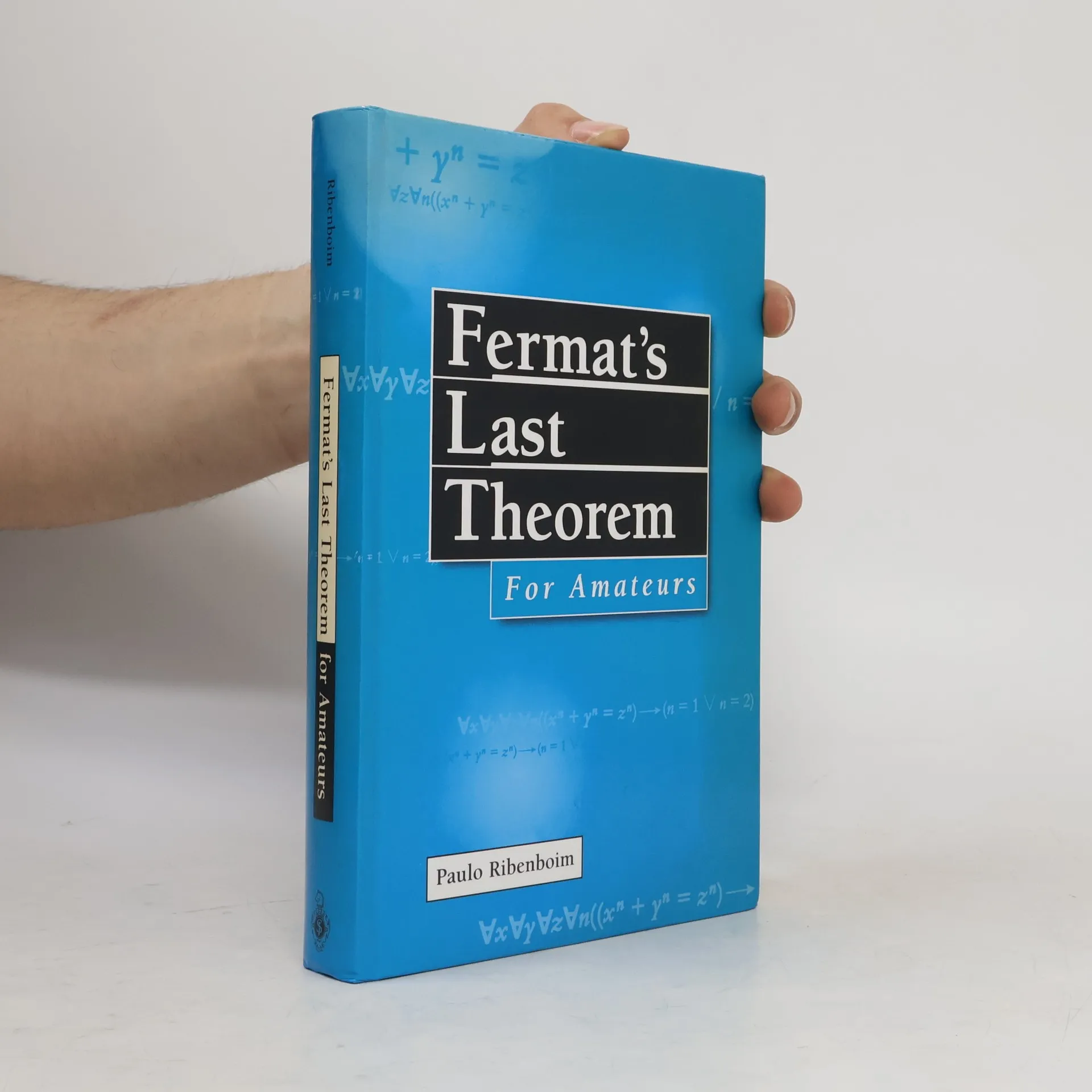
Fermats Last Theorem for Amateurs
- 424 Seiten
- 15 Lesestunden
Fermat's Last Theorem, proven after centuries of effort, is explored through the lens of various mathematical contributions, emphasizing the roles of elliptic curves, modular forms, and Galois representations. The book is designed for amateurs and educators, focusing on elementary methods that, while not yielding a complete proof, showcase intriguing results related to the theorem. It offers a self-contained narrative with detailed explanations, primarily involving rational numbers, and excludes certain advanced contributions to maintain accessibility.
- 2012
The Book of Prime Number Records
- 504 Seiten
- 18 Lesestunden
Rooted in a 1984 lecture at Queen's University, this work explores the nuances of teaching and learning, particularly in relation to numerical concepts across cultures. The author reflects on the unique linguistic traits of a tribe in Brazil that lacks a term for "two," highlighting the diversity of mathematical understanding. Additionally, a humorous anecdote about a tedious 800-page book illustrates the balance between numbers and language, emphasizing the intention to present a text rich in both numerical and verbal content. Acknowledgments are given to Linda Nuttall for her meticulous work on the manuscript.
- 2012
The Theory of Classical Valuations
- 420 Seiten
- 15 Lesestunden
The book delves into Kummer's innovative "local" methods in the study of cyclotomic fields, pivotal for proving his significant theorem related to Fermat's Last Theorem. It explores the concept of "ideal numbers" and their divisibility, particularly focusing on the lambda value defined as 1 - psi, where psi represents a primitive root. This work not only sheds light on Kummer's contributions to number theory but also highlights the intricate relationships within algebraic structures.
- 2012
The New Book of Prime Number Records
- 568 Seiten
- 20 Lesestunden
Exploring the fascinating world of prime numbers, this book builds on a lecture given at Queen's University and reflects on the nature of numeracy, referencing unique cultural perspectives. It highlights the contrast between vast numerical concepts and the simplicity of language, illustrated by a tribe in Brazil lacking a term for "two." The text promises a blend of engaging words and numbers, featuring updated sections and records compared to its predecessor, aiming to captivate readers with the allure of prime numbers and mathematical curiosities.
- 2010
13 Lectures on Fermat's Last Theorem
- 328 Seiten
- 12 Lesestunden
Fermat's last theorem has captivated mathematicians for over three centuries, inspiring numerous theories and methods aimed at its proof. This collection of lectures offers a concise overview of the theorem's history, recent results, and key theories related to the problem. The content is accessible to a general mathematical audience, though some details may be abbreviated. The final lectures explore analogues to Fermat's theorem. A forthcoming companion book will delve deeper into the technical aspects for those seeking a more comprehensive understanding.
- 2010
Classical Theory of Algebraic Numbers
- 708 Seiten
- 25 Lesestunden
The book offers a comprehensive exploration of algebraic numbers, tracing their development from Gauss's binary quadratic forms to Kummer's ideals and cyclotomic fields. It features a clear exposition of classical theory, supported by numerous exercises and numerical examples. The structure includes sections on residue classes, algebraic integers, and Kummer's theory, culminating in analytical methods like Dirichlet's Theorem. This resource serves as a solid foundation for understanding advanced topics in diophantine equations and arithmetic algebraic geometry.
- 2009
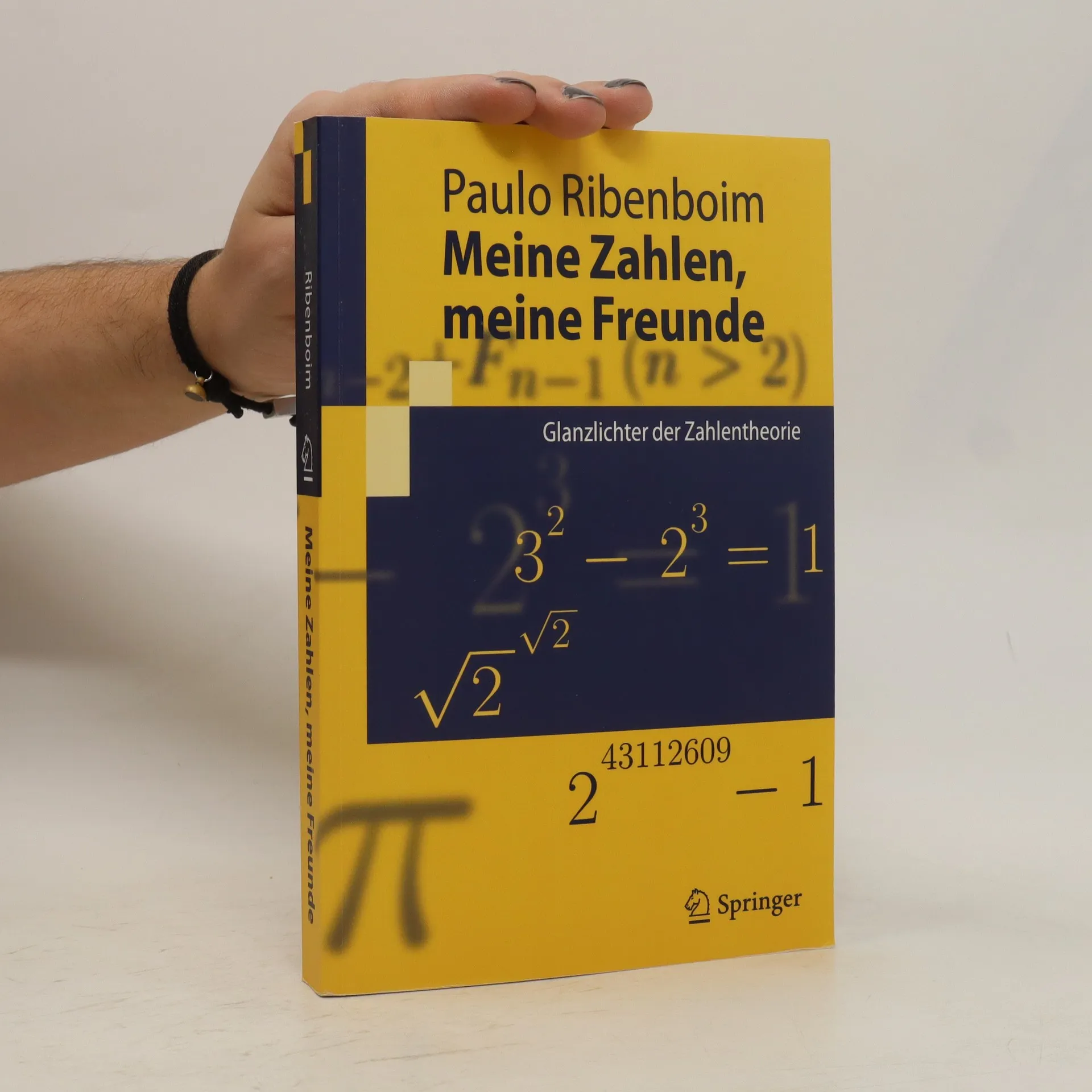
Meine Zahlen, meine Freunde
Glanzlichter der Zahlentheorie
Paulo Ribenboim behandelt Zahlen in dieser außergewöhnlichen Sammlung von Übersichtsartikeln wie seine persönlichen Freunde. In leichter und allgemein zugänglicher Sprache berichtet er über Primzahlen, Fibonacci-Zahlen (und das Nordpolarmeer!), die klassischen Arbeiten von Gauß über binäre quadratische Formen, Eulers berühmtes primzahlerzeugendes Polynom, irrationale und transzendente Zahlen. Nach dem großen Erfolg von „Die Welt der Primzahlen" ist dies das zweite Buch von Paulo Ribenboim, das in deutscher Sprache erscheint.
- 2006
Die Welt der Primzahlen
- 356 Seiten
- 13 Lesestunden
Die Welt der Primzahlen - in faszinierender Weise stellt Paulo Ribenboim die wesentlichen Ergebnisse zu den Bausteinen der natürlichen Zahlen vor. Fundamentale Sätze, offene Fragen und ungelöste Probleme bereichert er durch eine wohl einmalige Sammlung von Rekorden über Primzahlen. Eine umfangreiche Liste mit Literaturhinweisen ergänzt das Buch und macht es zu einer wichtigen Quelle für alle Leser, die sich für die Zahlentheorie interessieren.