

Air has an existential significance for all forms of life in the world. It is everywhere, albeit invisible and evanescent; it is literally impalpable. While in everyday life we have taken air for granted, in current political and social discourses air appears as a central theme during the corona crisis, where we wear face masks to protect others from the air we breathe out; scientists are investigating the role of aerosols in the transmission of the COVID-19 virus, and climate activists fight for clean air and hence against climate change. The depiction of air has been one of the artistic challenges at least since the Renaissance. As a material, however, air is a relatively recent phenomenon in art. The artists of Modernism strived for the artistic appropriation of the world as well as its dissolution and transformation. It therefore seems logical that they regarded air not only as an idea, but also as a material. Air was no longer depicted merely as wind, clouds, fog, steam, smoke, or breath, but has been deliberately used as a material. Thus it has been both a medium of expression as well as a subject in the visual, applied, and performing arts since then.
Barbara J. Scheuermann Bücher

The focus of Candice Breitz's artistic work is on the examination of the influence of family, society, or communities that form the basis of certain affiliations such as race, gender, nationality, or religion, as well as on the importance of the media, which creates new groups and associations. Feminist matters are the focus of this presentation. The Kunstmuseum Bonn presents a comprehensive solo exhibition about the artist Candice Breitz (*1972 in Johannesburg), who grew up in South Africa and lives in Berlin, with video installations and photographs from the last 25 years. The exhibition presents works ranging from the early Ghost Series (1994), a series of photographs that reflected on the violence of whiteness under the apartheid regime at the moment of South Africa’s political transformation in 1994, to more recent works such as TLDR (2017), a 13-channel video installation, which was created in collaboration with a community of South African sex workers, which deals with their worldwide struggle for basic human rights. For her most recent work Labour, which also was the inspiration for the exhibition title Breitz has filmed several women while giving birth. In addition to the exhibition documentation, the accompanying book offers an overview of all works since 2010.
Stories
Erzählstrukturen in der zeitgenössischen Kunst : Eija-Liisa Ahtila, Lars Arrhenius, Birgit Brenner ...
- 176 Seiten
- 7 Lesestunden
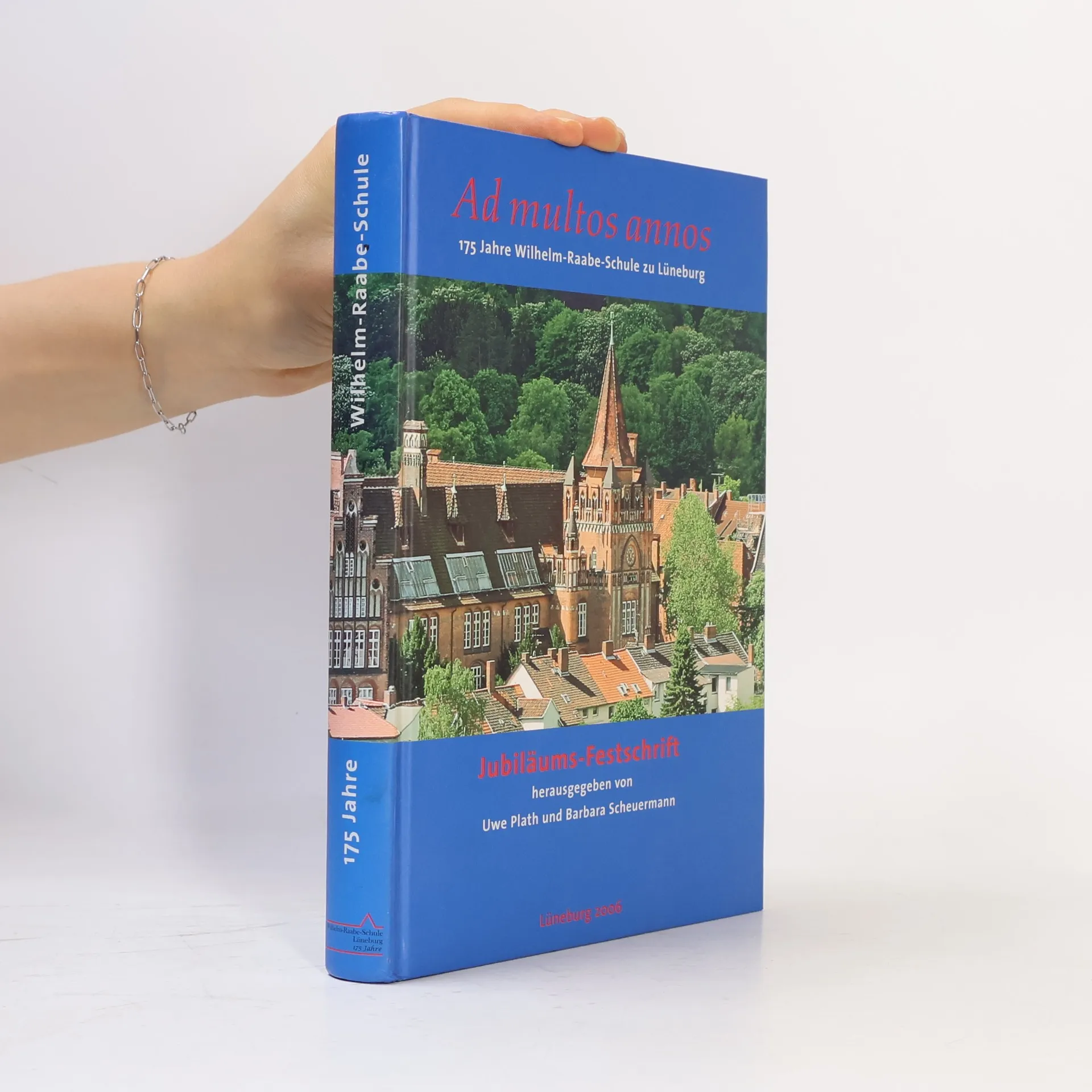
Ad multos annos
175 Jahre Wilhelm-Raabe-Schule zu Lüneburg - Jubiläums-Festschrift
Schulgeschichte zwischen 1831 und 2006 – in zum Teil bisher noch nicht veröffentlichten zeitgenössischen Quellen, in Darstellungen und Erinnerungen, durch die ein perspektivenreiches Gesamtbild entsteht. Schulgeschichte zwischen 1831 und 2006 – mit bewegenden Ereignissen, interessanten Projekten, nachhaltigen Erfahrungen, die die Wilhelm-Raabe-Schule in Lüneburg, die vormalige Töchterschule, und die Schulgemeinschaft geprägt haben. Diese Festschrift vermittelt das Bild einer ganz besonderen Schule und spiegelt zugleich Aspekte Lüneburgischer Geschichte.