

There are many myths surrounding the development of the Messerschmitt Me 262 jet fighter. Its unparalleled performance is beyond doubt; easily able to outpace its opponents and possessing the firepower to shred them in seconds. Yet immediately after the Second World War, rumors abounded that official indifference, technical shortcomings and interference from the Führer himself had crippled the Me 262’s progress and delayed its appearance on the front line until it was far too late.Begun as a series of design concepts during 1938, the fighter would not enter mass production until the spring of 1944. Even then it failed to make any notable impact until the closing weeks of the war, when Me 262s began destroying USAAF bombers at an alarming rate. Exactly what happened to cause this apparently late start and who was responsible has until now been largely a matter of conjecture.Grounded in research involving thousands of wartime documents spread across archival collections in three countries, Messerschmitt Me 262 Development & Politics finally sweeps aside the myths and provides a clear understanding of the real history. Sharp examines the aircraft’s technical development in unparalleled detail as well as analyzing the ongoing discussions surrounding the Me 262 at the highest levels within the Messerschmitt company, the German Air Ministry and Adolf Hitler’s inner circle.
Dan Sharp Bücher

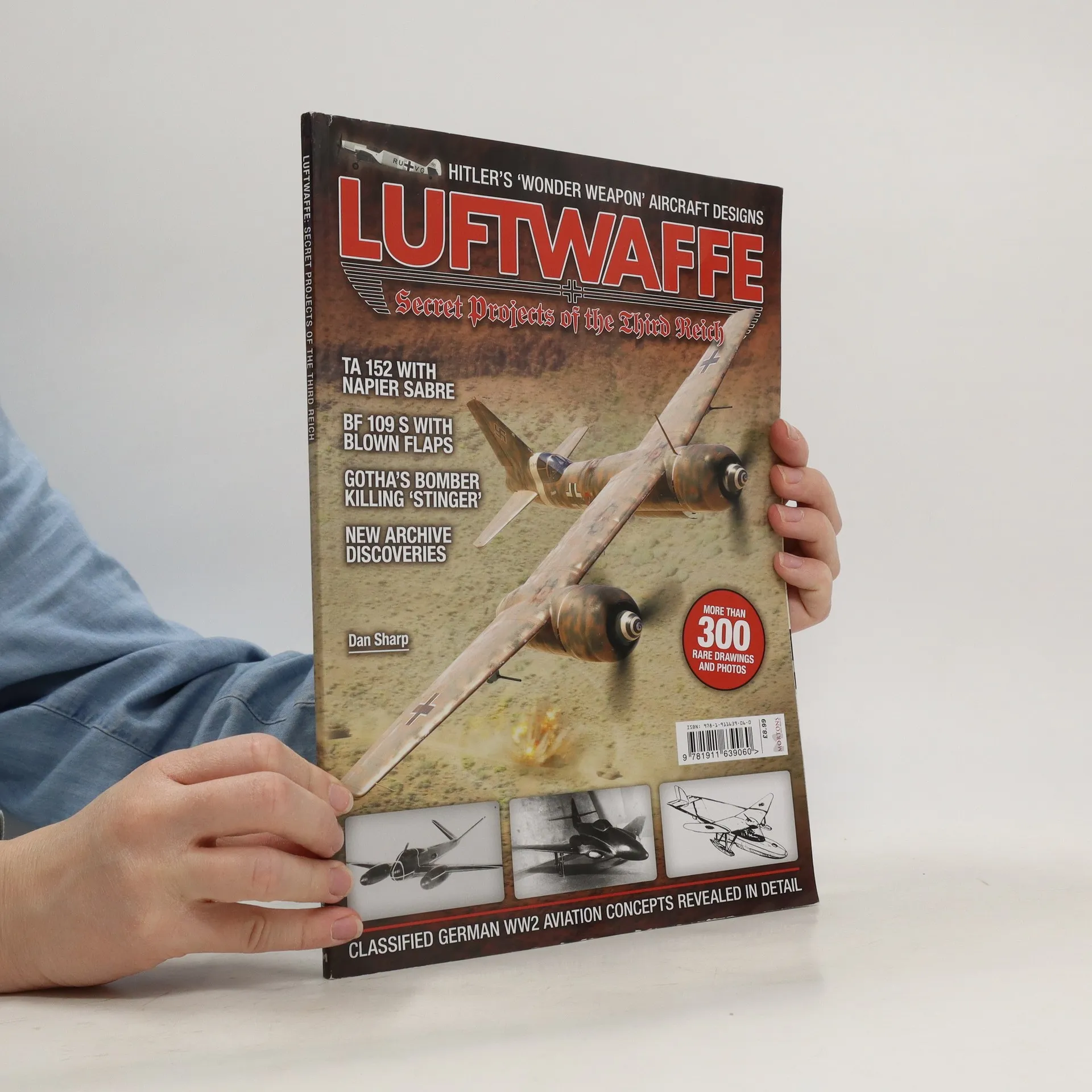
Luftwaffe Secret Projects of the Third Reich
- 132 Seiten
- 5 Lesestunden
Hundreds of thousands of classified documents were captured from Germany’s aircraft manufacturers and aviation ministry at the end of the Second World War, including details of ‘secret project’ aircraft designs created by firms such as Arado, Gotha, Blohm & Voss, Messerschmitt and Focke-Wulf.Ongoing new research in archives around the world has revealed dozens of previously unknown wartime plans and proposals for aircraft that were radical, revolutionary or just plain weird. In the sixth volume of his Luftwaffe series, historian Dan Sharp reveals a wealth of new discoveries - including never-before-seen drawings and designs for fighters, bombers, transports, rammers, ground-attack aircraft, flying boats and flying bombs. Secret Projects of the Third Reich profiles Focke-Wulf’s reluctant attempts to marry a Ta 152 airframe to a British Napier Sabre engine, Messerschmitt’s experimental Me 109 S with ‘blown’ flaps, four versions of Arado’s E 380 floatplane, Blohm & Voss’s asymmetrical P 171 stuka, Lippisch’s piston-engined Me 163, Germany’s three-step supersonic research programme, Focke-Wulf’s giant flying wings, the anti-submarine DFS Lotos glider, and many more ‘unknown’ designs.Hundreds of original and previously unseen documents have been used to compile this unrivalled look at some of Germany’s least-known Second World War project designs, featuring a host of new and period drawings, illustrations and photographs.
Eagles of the Luftwaffe: Focke-Wulf Fw 190 A, F and G
- 116 Seiten
- 5 Lesestunden
When it appeared in the skies over Europe in 1941, the Focke-Wulf Fw 190 A was the best fighter in the world. It was more than a match for the best Spitfires the RAF could field and began shooting them down in ever-increasing numbers. Only the introduction of the Spitfire IX with its two-stage supercharged Merlin overturned its supremacy.Alongside the Messerschmitt Bf 109, the Fw 190 is the iconic fighter of the Luftwaffe during the Second World War. It was hugely adaptable and fought on nearly all fronts, proving to be a formidable opponent.The Fw 190 F and G fighter-bombers effectively replaced the Ju 87 Stuka in the ground-attack role in the west and provided the Luftwaffe with much-needed additional capability.The Fw 190 was used for the Mistel flying bomb combination and as a test aircraft for the Ruhrstahl X-4 wire-guided air-to-air missile, and in its Fw 190 A-8 and A-9 forms fought on the front line right until the bitter end.This book tells the story of the legendary fighter with previously unseen drawings and photos which shed new light on the aircraft’s origins.
The narrative delves into the intricate development programs of Germany's bombers during World War II, exploring the technological advancements and strategic decisions that shaped their aircraft. It highlights key figures involved in the design and production processes, as well as the impact of these innovations on warfare. The book provides insights into the challenges faced by engineers and the military, offering a detailed examination of how these programs influenced the course of the war and the evolution of aerial combat.