

Andreas Capellanus wrote De Amore, his famous Latin treatise on marriage, around 1186. Enhanced by theological, medical and legal wisdom, his book of the art of loving greatly influenced the literature of courtly love during the Middle Ages. This monolingual textbook edition provides a modern German translation in addition to explanatory notes on the sources and a language commentary to aid comprehension of particular passages and the difficulties of translation. A bibliography and a postscript that sets the work in its literary context round off this new translation. In terms of the history of human thought and literature, this famous text is of great relevance to students, literary scholars and medievalists alike, and serves as the basis for an understanding of courtly love poetry during the Middle Ages.
Andreas Capellanus Bücher
Andreas Capellanus, Autor einer Abhandlung, die oft als Die Kunst der höfischen Liebe bekannt ist, bietet eine anspruchsvolle, vielleicht zynische Perspektive auf die mittelalterliche Romanze. Auf Wunsch von Marie de Champagne für einen jungen Schüler geschrieben, befasst sich sein Werk mit den Feinheiten der Liebe, definiert deren Natur, veranschaulicht romantische Interaktionen zwischen sozialen Schichten und erzählt Geschichten von tatsächlichen Höfen. Dieser einflussreiche Text dient als wertvolle, wenn auch umstrittene Aufzeichnung der Einstellungen und Praktiken, die die westlichen literarischen Traditionen begründeten, wobei moderne Gelehrte ihn oft als subtile Kritik an der aristokratischen Oberflächlichkeit interpretieren.


Bibliothek der Mittellateinischen Literatur - 1: Über die Liebe / De amore
Ein Lehrbuch des Mittelalters über Sexualität, Erotik und die Beziehungen der Geschlechter
- 276 Seiten
- 10 Lesestunden
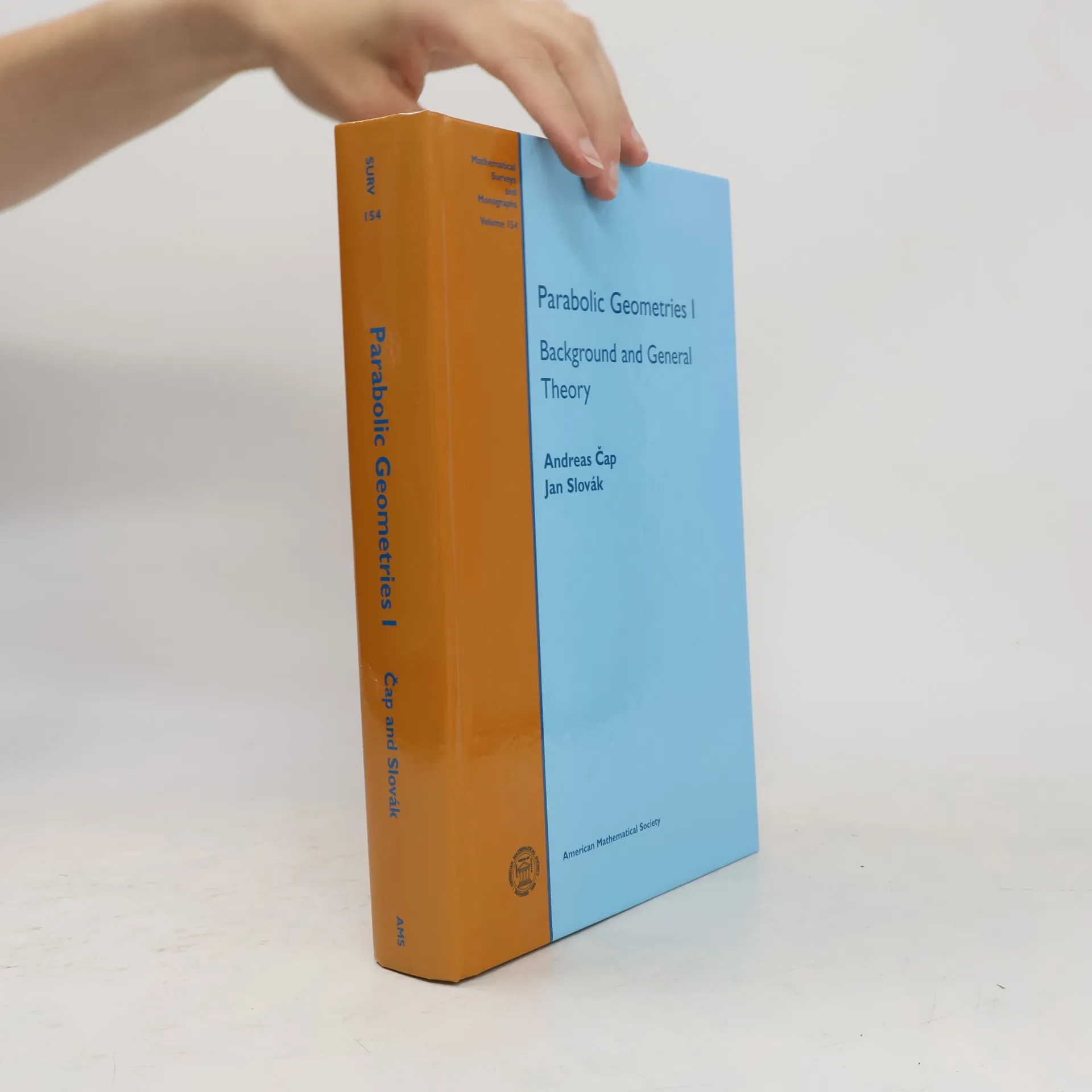
Mathematical Surveys and Monographs - 154: Parabolic Geometries I
Background and General Theory
- 628 Seiten
- 22 Lesestunden
Parabolic geometries encompass a very diverse class of geometric structures, including such important examples as conformal, projective, and almost quaternionic structures, hypersurface type CR-structures and various types of generic distributions. The characteristic feature of parabolic geometries is an equivalent description by a Cartan geometry modeled on a generalized flag manifold (the quotient of a semisimple Lie group by a parabolic subgroup). Background on differential geometry, with a view towards Cartan connections, and on semisimple Lie algebras and their representations, which play a crucial role in the theory, is collected in two introductory chapters. The main part discusses the equivalence between Cartan connections and underlying structures, including a complete proof of Kostant's version of the Bott-Borel-Weil theorem, which is used as an important tool. For many examples, the complete description of the geometry and its basic invariants is worked out in detail. The constructions of correspondence spaces and twistor spaces and analogs of the Fefferman construction are presented both in general and in several examples. The last chapter studies Weyl structures, which provide classes of distinguished connections as well as an equivalent description of the Cartan connection in terms of data associated to the underlying geometry. Several applications are discussed throughout the text.