

The first book to examine the battleship-led 1941 Pacific Fleet as it was intended to fight. Packed with illustrations, this study explains how the US Navy saw the approaching war unfolding. When the Japanese attacked Pearl Harbor, the Pacific Fleet was the most powerful in the US Navy. It was still dominated by battleships, but since the late 1930s had been developing naval aviation and integrating them with its battleship-led doctrine. This book is the first to examine the Pacific Fleet as it was intended to fight, and how it had been training and preparing in the months leading up to December 7, 1941. Naval historian Mark Lardas explains how, contrary to modern assumptions, it was not wedded to the battleship, but was hedging its bets, building up both its carrier and battleship strength. Most crucially, it had also been building and honing a massive fleet train, enabling the Pacific Fleet to operate easily thousands of miles from home. It was this foundation that enabled the Pacific Fleet to adapt so rapidly to the new world of carrier-led naval warfare, and first check and then defeat the IJN. With artwork, photos and diagrams, this is a portrait of 1941 in the Pacific Fleet, the last time and place when battleship doctrine held sway. Pearl Harbor would shatter this, and herald the start of the carrier era. The blow fell heavily on the US Pacific Fleet, but it and its successors would emerge more powerful than ever.
Mark Lardas Reihenfolge der Bücher


- 2024
- 2024
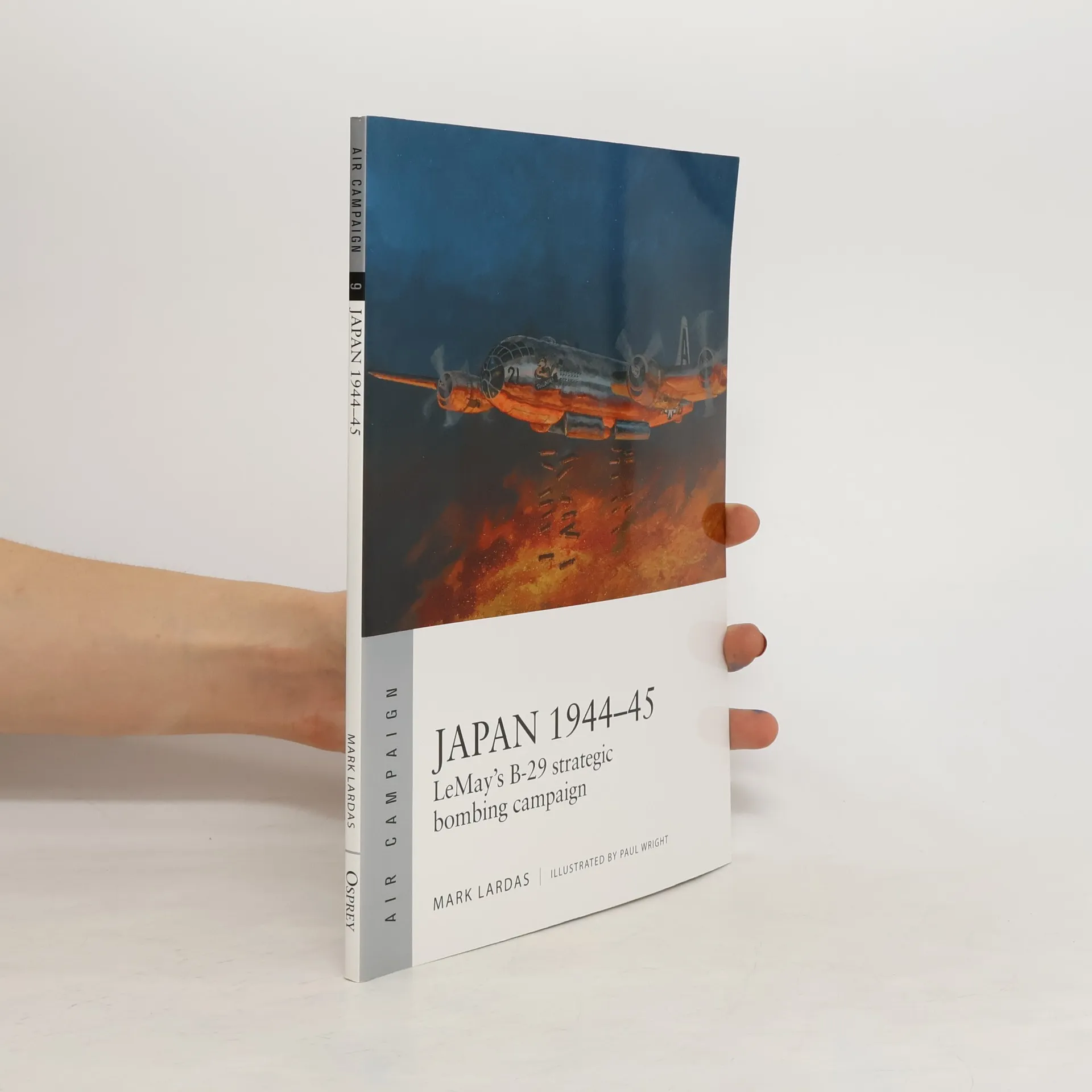
The full history of how the United States targeted and destroyed the Japanese capital from the air, in a ten-month long campaign by the US Army Air Force and the US Navy. In November 1944, the US Army Air Force launched a 111-plane B-29 strike against Tokyo, the first raid since the morale-boosting Doolittle Raid of 1942. From then until August 13, 1945, the United States would attack Tokyo 25 times, 20 from B-29s based in the Marianas and five from US Navy carrier task forces. The campaign included the single deadliest air raid in human history, when around 100,000 people were killed by the firestorm created by the Operation Meetinghouse raid of March 10, 1945. This book, the first to examine the full history of the United States' air campaign against the greatest target in Japan, looks at the USAAF's and US Navy's efforts to use air power to eliminate Tokyo's strategic value to the Empire. It considers how the campaign developed from daylight bombing to firebombing and anti-ship mining, and finally how the target was handed over to the US Navy, whose carrier-based bombers and fighter-bombers continued to strike Tokyo during July and August 1945. Using specially commissioned battlescenes, strategic maps and diagrams, this volume presents a detailed picture of how Tokyo was vanquished from the air.
- 2023
An absorbing study of the duels fought between the US Navy's escort warships and Hitler's U-boats between December 1941 and May 1945.Although the Battle of the Atlantic lasted several years, its most critical phase began once the United States entered World War II. By December 1941, the British had mastered the U-boat threat in the Eastern Atlantic, only to see the front abruptly expand to regions the US Navy would patrol, chiefly the Atlantic Seaboard. Unless the US Navy overcame the U-boat threat, the Allies would struggle to win.The Battle of the Atlantic was made up of thousands of individual aircraft against U-boats, aircraft against aircraft, aircraft against ships-but most crucially, ships against U-boats. The individual clashes between Germany's U-boats and the Allied warships escorting the vital convoys often comprised one-on-one actions. These stories provide the focus of this detailed work. The technical details of the U-boats, destroyers, and destroyer escorts involved are explored in stunning illustrations, including ship and submarine profiles and weaponry artworks, and key clashes are brought to life in dramatic battlescenes. Among the clashes covered are including USS Kearny vs. U-568, USS Roper (DD-147) vs U-85, USS Eugene E. Elmore (DE-686) vs U-549, and USS Atherton (DE-169) vs U-853.
- 2023
South China Sea 1945
- 96 Seiten
- 4 Lesestunden
- 2023
Corregidor 1945
- 96 Seiten
- 4 Lesestunden
A detailed and fascinating exploration of the 1945 US combined land, naval and air operation to retake Corregidor and the other Japanese-held islands in Manila Bay from a determined and well-entrenched enemy. The islands guarding the entrance to Manila Bay, Luzon, had been seized by the Japanese in May 1942. In February 1945, US forces were back, and closed in on Manila from the north and south against heavy Japanese resistance. A joint US parachute and amphibious assault was planned to capture the largest island Corregidor, using the much-reinforced 503rd PRCT and elements of the 24th Infantry Division and 2nd Engineer Special Brigade. Facing them were over 6,000 Japanese troops recently evacuated from Bataan, where they had been cut off by advancing US forces. General MacArthur desired the island, once a symbol of American defiance, to be liberated with a flourish. This superbly illustrated work examines the ambitious US assault on Corregidor, which witnessed the most dangerous and risky parachute drop in airborne history, and vicious, desperate fighting by the defenders as they sought to prevent American troops from taking the island. It also covers the recapture of other islands defending Manila Bay: El Fraile/Fort Drum, Caballo, and Carabao.
- 2023
An illustrated examination of the role played by the Sunderland as an antisubmarine aircraft during the Battle of the Atlantic, focusing on the key battles of the Biscay campaign in 1943–44. The Sunderland is an iconic British aircraft of World War II, and the only RAF Coastal Command type to perform frontline service throughout the conflict. Its prime target – the German U-boat – was a deadly adversary to Allied warships and other oceangoing vessels, but proved vulnerable to detection and air attacks from the radar-equipped Sunderland. This book examines the respective advantages and drawbacks of these two maritime predators by providing a vivid analysis of their historic engagement during the Biscay campaign in 1943–44. Drawing upon first-hand accounts of this famous duel, Mark Lardas tells the story of how highly skilled Sunderland crews took the fight to an often elusive enemy and helped RAF Coastal Command defeat the U-boat threat. Maps, tactical diagrams, photographs and specially commissioned artwork bring the action to life as the Sunderland's losses – and eventual victory – in the Bay of Biscay play out in fascinating, insightful detail.
- 2022
A new history of the most crucial few months of the Arctic Convoys, when Germany's air power forced the Allies to retreat to the cover of winter.Between spring and autumn 1942, Germany was winning the battle of the Arctic Convoys. Half of PQ-15 was sunk in May, PQ-17 was virtually obliterated in July, and in September 30 percent of PQ-18 was sunk. The Allies were forced to suspend the convoys until December, when the long Arctic nights would shield them.Mark Lardas argues that in 1942, it was Luftwaffe air power that made the difference. With convoys sailing in endless daylight, German strike aircraft now equipped and trained for torpedo attacks, and bases in northern Norway available, the Luftwaffe could wreak havoc. Three-quarters of the losses of PQ-18 were due to air attacks. But in November, the Luftwaffe was redeployed south to challenge the Allied landings in North Africa, and the advantage was lost. Despite that, the Allies never again sailed an Arctic convoy in the summer months.Fully illustrated with archive photos, striking new artwork, maps and diagrams, this is the remarkable history of the Luftwaffe's last strategic victory of World War II.
- 2022
The Kamikaze Campaign 1944-45
- 96 Seiten
- 4 Lesestunden
This illustrated history details Japan's development and execution of a new air campaign in late 1944, characterized by the kamikaze assaults against the advancing Allied fleets. As the war turned against Japan, the nation sought extraordinary measures to avoid surrender, leading to the formation of Special Attack Units, or kamikazes. The idea of organized suicide squadrons emerged on June 15, 1944, with training beginning by August. These units were first deployed during the October 1944 invasion of the Philippine Islands, achieving some tactical success. The campaign expanded throughout the Pacific War, peaking during the Battle of Okinawa in April-May 1945. This history explores not only the harrowing missions but also the strategic decisions that shaped the kamikaze campaign, which evolved from ad hoc attacks into a central component of Japanese military policy. By war's end, Japan was producing aircraft specifically for kamikaze missions, including a rocket-powered manned missile. A comprehensive plan for a large-scale kamikaze defense of the Home Islands was devised but was never implemented due to Japan's surrender in August 1945. The book is enriched with diagrams, maps, and 3D reconstructions, while also evaluating Allied countermeasures and their effectiveness.
- 2022
The Capture of U-505
- 80 Seiten
- 3 Lesestunden
U-505 was the first enemy warship captured at sea by the US Navy since 1812. This account details how Captain Gallery devised and executed a daring raid on his own initiative, a success that nearly jeopardized the war against U-boats. On June 4, 1944, a US Navy antisubmarine task group captured an enemy U-boat in the Atlantic. Unlike previous captures, the operation involved a risky strategy to seize scuttled U-boats. The book analyzes Gallery's bold approach, using contemporary sources to explain his belief that the potential rewards outweighed the risks. Instead of sinking the next surfaced U-boat, a destroyer escort would deploy its whaleboat while others provided suppressive fire to encourage the crew to abandon ship. Unbeknownst to Gallery, the Allies had already broken German codes, and capturing a U-boat could compromise this intelligence. His goal was to secure the vessel's codes and equipment to intercept U-boat communications. The operation culminated in the capture of U-505, which nearly exposed the Bletchley Park codebreaking efforts. Featuring contemporary photographs, commissioned artwork, and 3D maps, this narrative explores a controversial raid that could have altered the course of World War II.
- 2021
Battle of the Atlantic 1942-45
- 96 Seiten
- 4 Lesestunden