

Sextus Empiricus (ca. 160–210 CE), exponent of scepticism and critic of the Dogmatists, was a Greek physician and philosopher, pupil and successor of the medical sceptic Herodotus (not the historian) of Tarsus. He probably lived for years in Rome and possibly also in Alexandria and Athens. His three surviving works are 'Outlines of Pyrrhonism' (three books on the practical and ethical scepticism of Pyrrho of Elis, ca. 360–275 BCE, as developed later, presenting also a case against the Dogmatists); 'Against the Dogmatists' (five books dealing with the Logicians, the Physicists, and the Ethicists); and 'Against the Professors' (six Grammarians, Rhetors, Geometers, Arithmeticians, Astrologers, and Musicians). These two latter works might be called a general criticism of professors of all arts and sciences. Sextus's work is a valuable source for the history of thought especially because of his development and formulation of former sceptic doctrines.The Loeb Classical Library edition of Sextus Empiricus is in four volumes.
Sextus Empiricus Bücher
Ein antiker medizinischer und philosophischer Gelehrter aus dem Mittelmeerraum, dessen philosophisches Werk die vollständigste erhaltene Darstellung des antiken griechischen und römischen Skeptizismus darstellt. Während die Medizintradition ihn der „empirischen Schule“ zuordnet, wie sein Name andeutet, deuten seine philosophischen Ansichten zumindest zweimal in seinen Schriften auf eine engere Verbindung zur „methodischen Schule“ hin.
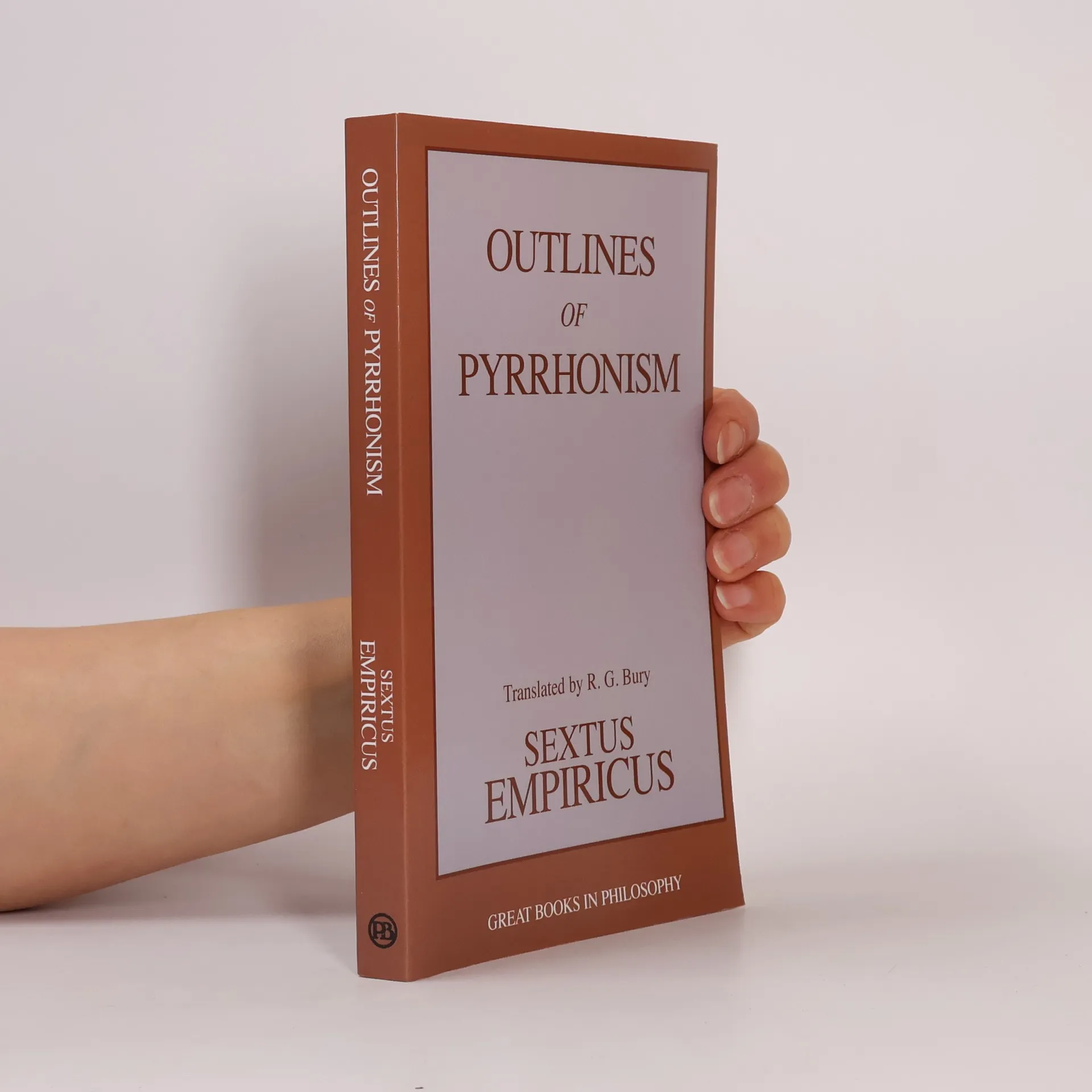
Great Books in Philosophy: Outlines of Pyrrhonism
- 283 Seiten
- 10 Lesestunden
Throughout history philosophers have sought to define, understand, and delineate concepts important to human well-being. One such concept is "knowledge." Many philosophers believed that absolute, certain knowledge, is possible—that the physical world and ideas formulated about it could be given solid foundation unaffected by the varieties of mere opinion. Sextus Empiricus stands as an example of the "skeptic" school of thought whose members believed that knowledge was either unattainable or, if a genuine possibility, the conditions necessary to achieve it were next to impossible to satisfy. In other words, in the absence of complete knowledge, one must make do with the information provided by an imperfect world and conveyed to the mind through sense impressions that can often deceive us. Throughout his life Sextus Empiricus entered into intellectual combat with those who confidently claimed to possess indubitable knowledge. For skeptics, the best one can hope to achieve is a reasonable suspension of judgment—remaining ever mindful that claims to knowledge require careful scrutiny, thoughtful analysis, and critical review if we are to prevent ourselves and others from plunging headlong into mistaken notions.