

Buchbewertung
Mehr zum Buch
Numerical linear algebra is far too broad a subject to treat in a single introductory volume. Stewart has chosen to treat algorithms for solving linear systems, linear least squares problems, and eigenvalue problems involving matrices whose elements can all be contained in the high-speed storage of a computer. By way of theory, the author has chosen to discuss the theory of norms and perturbation theory for linear systems and for the algebraic eigenvalue problem. These choices exclude, among other things, the solution of large sparse linear systems by direct and iterative methods, linear programming, and the useful Perron-Frobenious theory and its extensions. However, a person who has fully mastered the material in this book should be well prepared for independent study in other areas of numerical linear algebra.
Buchkauf
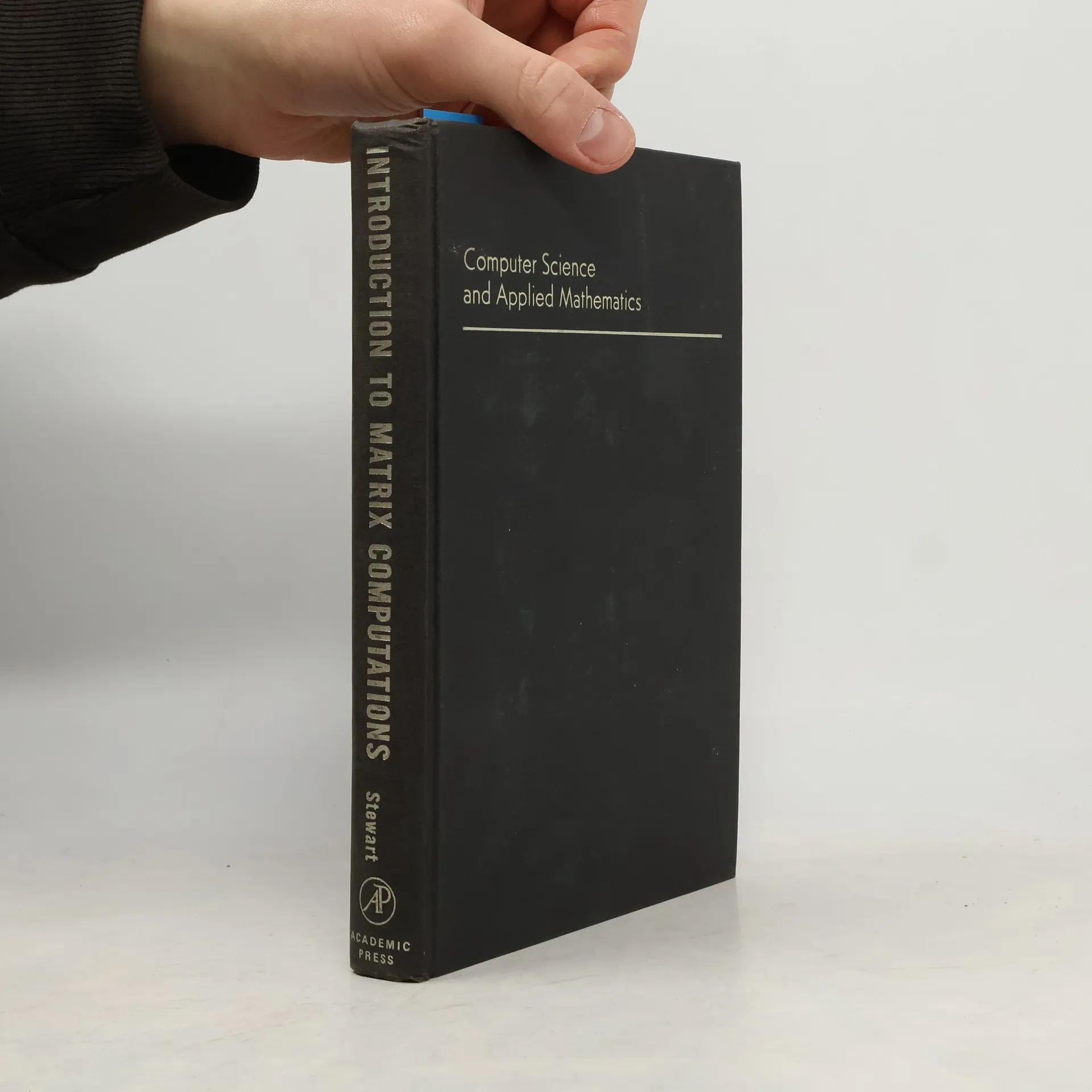
Computer Science and Applied Mathematics: Introduction to Matrix Computations, Gilbert W. Stewart
- Sprache

- Erscheinungsdatum
- 1973
- Einband
- (Hardcover)
Hier könnte deine Bewertung stehen.
- Titel
- Computer Science and Applied Mathematics: Introduction to Matrix Computations
- Sprache
- Englisch
- Autor*innen
- Gilbert W. Stewart
- Verlag
- Academic press
- Erscheinungsdatum
- 1973
- Einband
- Hardcover
- Seitenzahl
- 441
- ISBN10
- 0126703507
- ISBN13
- 9780126703504
- Reihe
- Kategorien
- Schlagwörter
- Algebra, Datenverarbeitung
- Bewertung
- 5 von 5 Sternen
- Beschreibung
- Numerical linear algebra is far too broad a subject to treat in a single introductory volume. Stewart has chosen to treat algorithms for solving linear systems, linear least squares problems, and eigenvalue problems involving matrices whose elements can all be contained in the high-speed storage of a computer. By way of theory, the author has chosen to discuss the theory of norms and perturbation theory for linear systems and for the algebraic eigenvalue problem. These choices exclude, among other things, the solution of large sparse linear systems by direct and iterative methods, linear programming, and the useful Perron-Frobenious theory and its extensions. However, a person who has fully mastered the material in this book should be well prepared for independent study in other areas of numerical linear algebra.