



Parameter
- 300 Seiten
- 11 Lesestunden
Mehr zum Buch
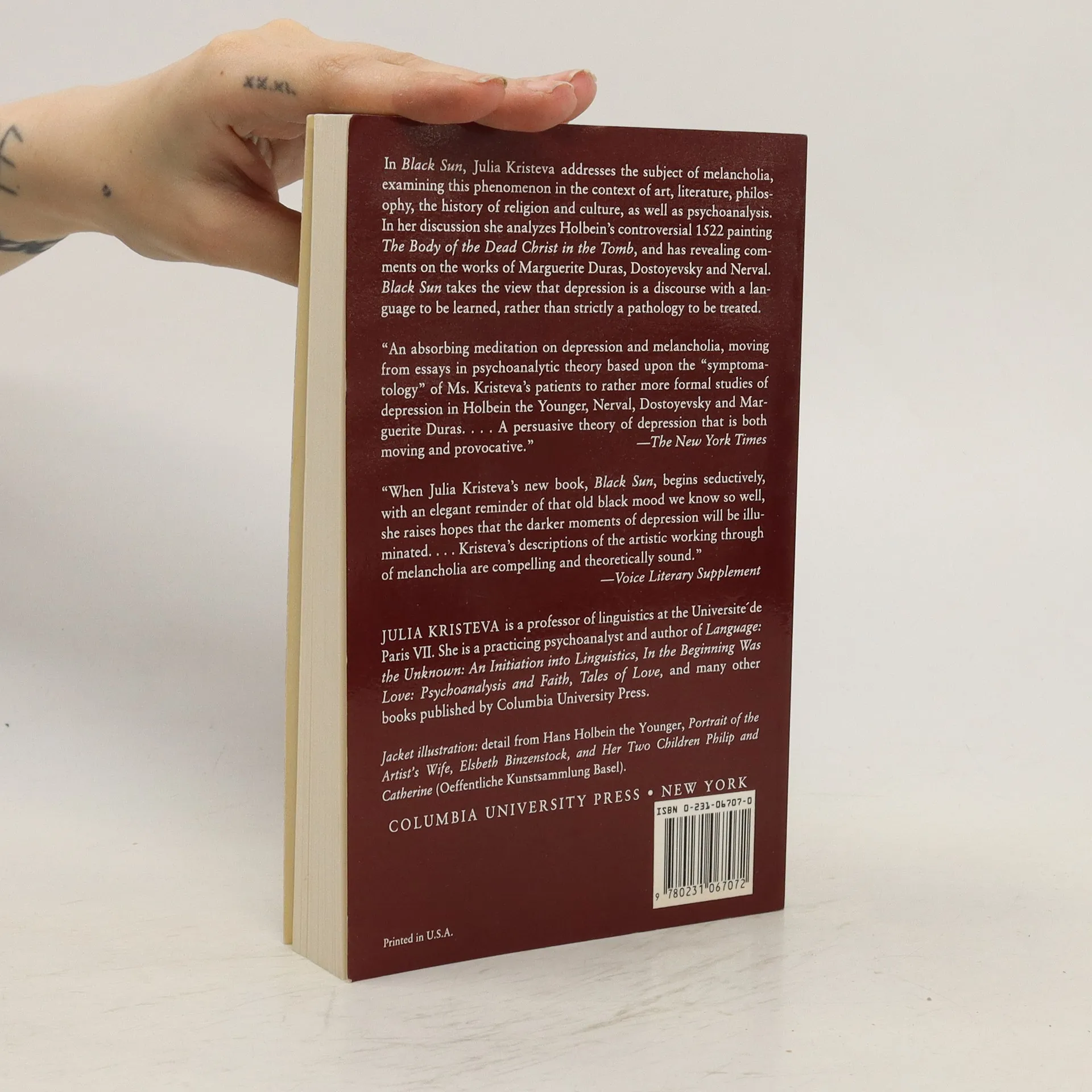
In Black Sun, Julia Kristeva addresses the subject of melancholia, examining this phenomenon in the context of art, literature, philosophy, the history of religion, and culture, as well as psychoanalysis. She describes the depressive as one who perceives the sense of self as a crucial pursuit and a nearly unattainable goal and explains how the love of a lost identity of attachment lies at the very core of depression's dark heart.In her discussion she analyzes Holbein's controversial 1522 painting "The Body of the Dead Christ in the Tomb," and has revealing comments on the works of Marguerite Duras, Dostoyevsky and Nerval. Black Sun takes the view that depression is a discourse with a language to be learned, rather than just strictly a pathology to be treated.




Buchkauf
Black Sun, Julia Kristeva
- Sprache

- Erscheinungsdatum
- 1989
- product-detail.submit-box.info.binding
- (Paperback)
Hier könnte deine Bewertung stehen.
- Titel
- Black Sun
- Sprache
- Englisch
- Autor*innen
- Julia Kristeva
- Erscheinungsdatum
- 1989
- Einband
- Paperback
- Seitenzahl
- 300
- ISBN10
- 0231067070
- ISBN13
- 9780231067072
- Reihe
- Schlagwörter
- Sachbücher, Kunst & Kultur, Sozialwissenschaften, Wahre Geschichten, Psychologische Thematik, Philosophisches Thema, Kunst, Philosophie, Psychologie, Meinungsjournalismus, Wissenschaftliche Theorien, Psychoanalyse
- Originaltitel
- Soleil noir
- Bewertung
- 4,1 von 5 Sternen
- Beschreibung
- In Black Sun, Julia Kristeva addresses the subject of melancholia, examining this phenomenon in the context of art, literature, philosophy, the history of religion, and culture, as well as psychoanalysis. She describes the depressive as one who perceives the sense of self as a crucial pursuit and a nearly unattainable goal and explains how the love of a lost identity of attachment lies at the very core of depression's dark heart.In her discussion she analyzes Holbein's controversial 1522 painting "The Body of the Dead Christ in the Tomb," and has revealing comments on the works of Marguerite Duras, Dostoyevsky and Nerval. Black Sun takes the view that depression is a discourse with a language to be learned, rather than just strictly a pathology to be treated.