





Parameter
- 680 Seiten
- 24 Lesestunden
Mehr zum Buch
The Handbook of Social Choice and Welfare, in two volumes, features essays on social choice theory and welfare economics. The first volume is divided into four parts. Part 1 focuses on Arrovian impossibility theorems, exploring the implications of the majority cycle identified by Condorcet and surveying various escape routes from such results. Part 2 examines the operation and performance of voting schemes and cost-sharing mechanisms, alongside modern theories of incentives and mechanism design. Part 3 delves into the structure of social choice rules, discussing positional rules of collective decision-making, game-theoretic aspects of committee voting, and the implications of interpersonal comparisons of welfare. It critically assesses utilitarianism as a theory of justice and surveys the foundations of measuring inequality and poverty. An extensive introduction by Kotaro Suzumura contextualizes these topics within the historical background of social choice theory, highlighting the impact of Arrow's work and the socialist planning controversy. The Handbook aims to provide an accessible overview of contemporary social choice theory and welfare economics, offering insights into human well-being and collective decision-making, while serving as a resource for evaluating new scholarship and synthesizing existing research.
Buchkauf
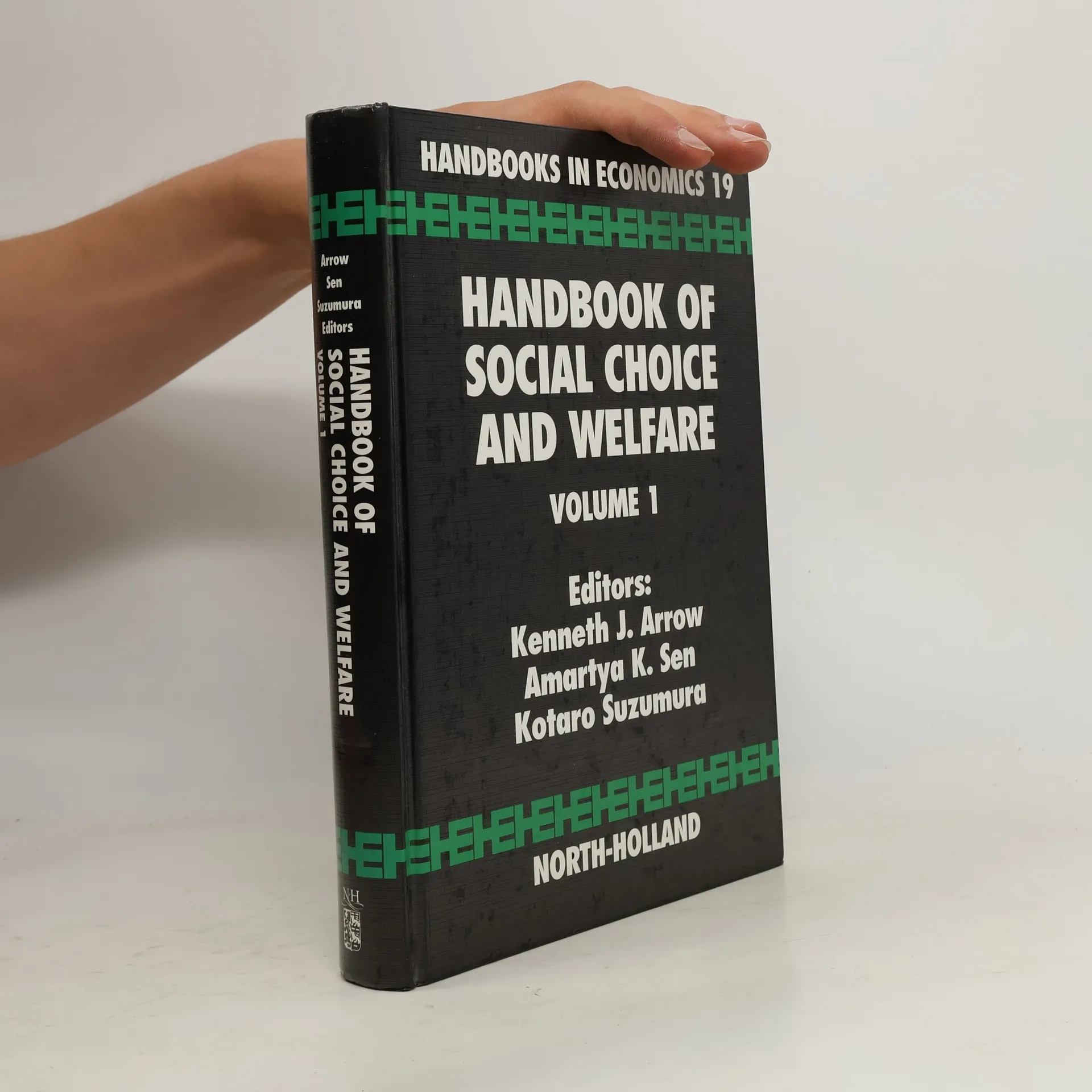
Handbooks in Economics - 19: Handbook of Social Choice and Welfare, Kenneth Arrow, Amartya Sen, Kotaro Suzumura
- Sprache

- Erscheinungsdatum
- 2002
- Einband
- (Hardcover),
- Buchzustand
- Beschädigt
- Preis
- 9,38 €inkl. MwSt.
Keiner hat bisher bewertet.
- Sprache
- Englisch
- Autor*innen
- Kenneth Arrow, Amartya Sen, Kotaro Suzumura
- Verlag
- North Holland
- Erscheinungsdatum
- 2002
- Einband
- Hardcover
- Seitenzahl
- 680
- ISBN10
- 0444829148
- ISBN13
- 9780444829146
- Reihe
- Schlagwörter
- Sachbücher, Sozialwissenschaften, Handel, Wirtschaft & Management, Politikwissenschaft, Ökonomie, Medizin, Soziologie, Management & Personalverwaltung, Finanzen, Finanzen & Buchhaltung, Politische Theorien, Wissenschaftliche Theorien, Westeuropa, Entwicklung, Zivilrecht, Sozialarbeit, Bankwesen, Mikroökonomie
- Beschreibung
- The Handbook of Social Choice and Welfare, in two volumes, features essays on social choice theory and welfare economics. The first volume is divided into four parts. Part 1 focuses on Arrovian impossibility theorems, exploring the implications of the majority cycle identified by Condorcet and surveying various escape routes from such results. Part 2 examines the operation and performance of voting schemes and cost-sharing mechanisms, alongside modern theories of incentives and mechanism design. Part 3 delves into the structure of social choice rules, discussing positional rules of collective decision-making, game-theoretic aspects of committee voting, and the implications of interpersonal comparisons of welfare. It critically assesses utilitarianism as a theory of justice and surveys the foundations of measuring inequality and poverty. An extensive introduction by Kotaro Suzumura contextualizes these topics within the historical background of social choice theory, highlighting the impact of Arrow's work and the socialist planning controversy. The Handbook aims to provide an accessible overview of contemporary social choice theory and welfare economics, offering insights into human well-being and collective decision-making, while serving as a resource for evaluating new scholarship and synthesizing existing research.